
Quantum Computing: A Simple Explanation with Examples
Quantum computers are a future technology that could revolutionize science and information technology: what are their components, how do they work, and what models exist within them.
Imagine your computer as a highly organized office worker. It receives tasks, follows instructions precisely, and executes everything in order: first, it checks email; second, it opens a web browser; third, it launches a game. Everything is clear and organized, but sometimes it can be incredibly slow, especially if you have a lot of tasks.

Now imagine a quantum computer. It’s not just an ordinary employee, but a superhero with superhuman abilities. It can solve multiple problems simultaneously, not one after another. Imagine being able to write a report, play a game, and watch a TV show all at the same time—all on a single machine, without any delay!
Why is everyone talking about quantum computers? Because they promise to be revolutionary. They can accomplish tasks that, for traditional computers, are like trying to remember every joke you’ve ever heard in a second.
Now let’s explore how these devices differ from the ones we’re used to and how they generally work.
What is a quantum computer?
If you think a quantum computer is some kind of high-tech laptop with RGB lighting, well… no.
In reality, it’s more like a science lab, where everything is built around one key component—a quantum processor.
Let’s take a look at the components of a quantum computer and why it looks the way it does.
The Quantum Processor (The Heart of the System)
This is the main component where all the calculations take place. A regular processor (for example, in a computer or smartphone) is made up of silicon transistors, while a quantum processor is made up of superconducting qubits (niobium (Nb) or aluminum (Al)).
What does it look like? A quantum processor is a tiny chip, about the size of a postage stamp. It contains tiny components that act as quantum qubits. For example, the Majorana 1 chip is one of the most advanced chips in this field.
What is it made of? Most often, it’s made of superconductors—special materials that begin to behave in ways necessary for quantum computing at extremely low temperatures.
Important: Quantum processors aren’t limited to superconducting qubits. There are many ways to create a quantum computer, each with its own unique characteristics. Here are the main options:
- Superconducting qubits are made of special materials that operate at extremely low temperatures;
- Neutral atoms—using atoms (such as rubidium) that are held together by lasers;
- Spin qubits made of silicon are similar to conventional processors but operate with quantum states;
- Photonic qubits—use particles of light (photons) for computation.
The choice of technology depends on the tasks to be solved. Each has its advantages and disadvantages, and scientists are still experimenting to find the optimal option.
Cooling System (Cryostat)
This is where things get interesting. Quantum computers operate at temperatures close to absolute zero.
What kind of cooling is this? Inside a quantum computer is a massive, multi-level refrigerator that gradually lowers the temperature to -273 degrees Celsius (just above absolute zero).
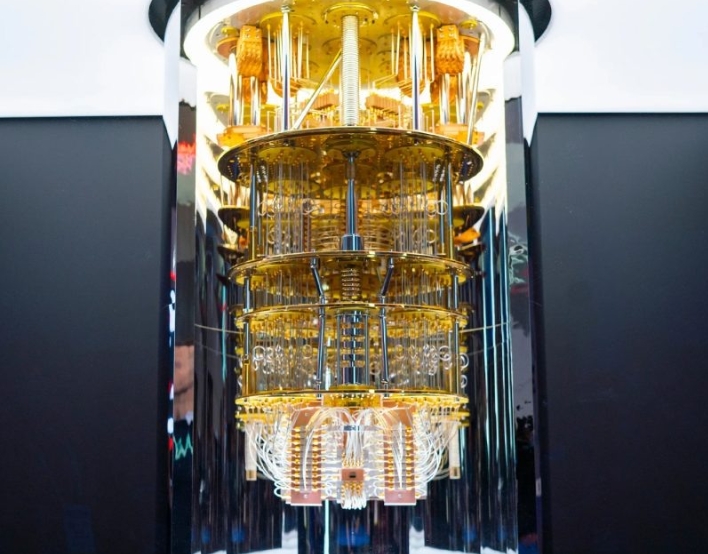
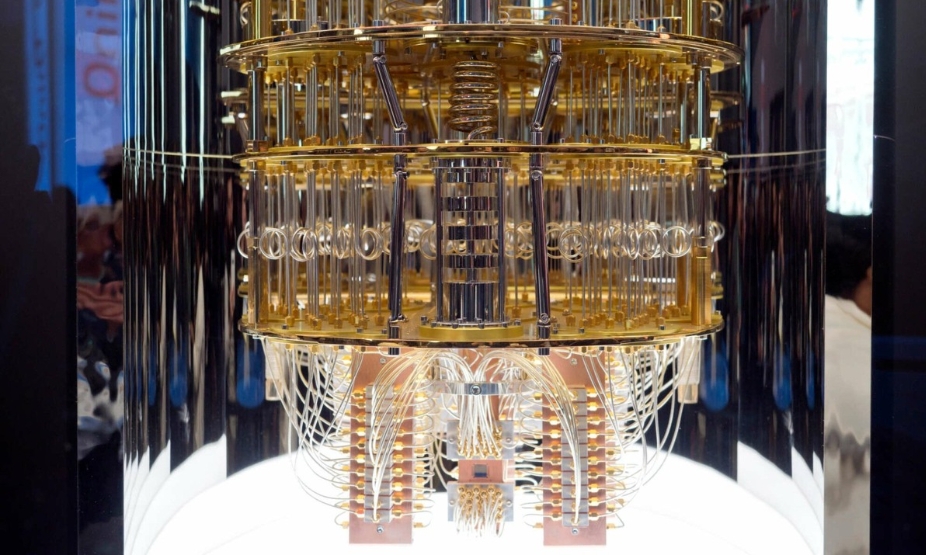
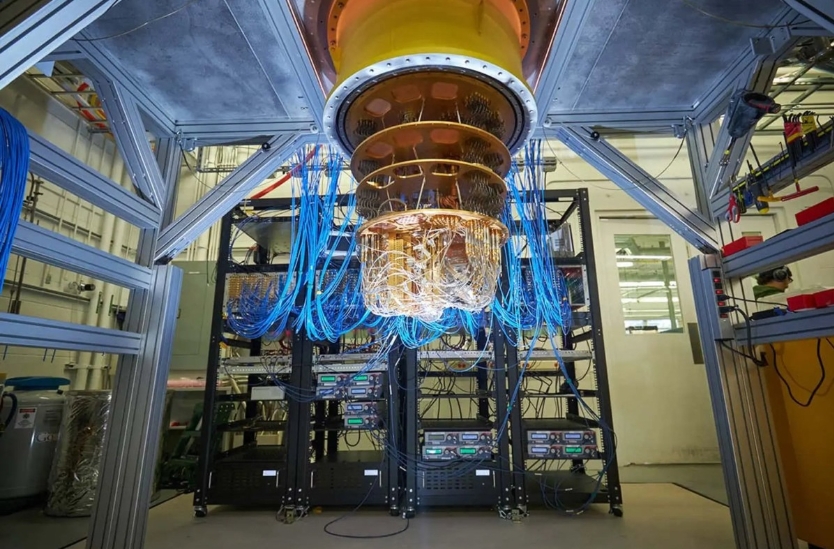
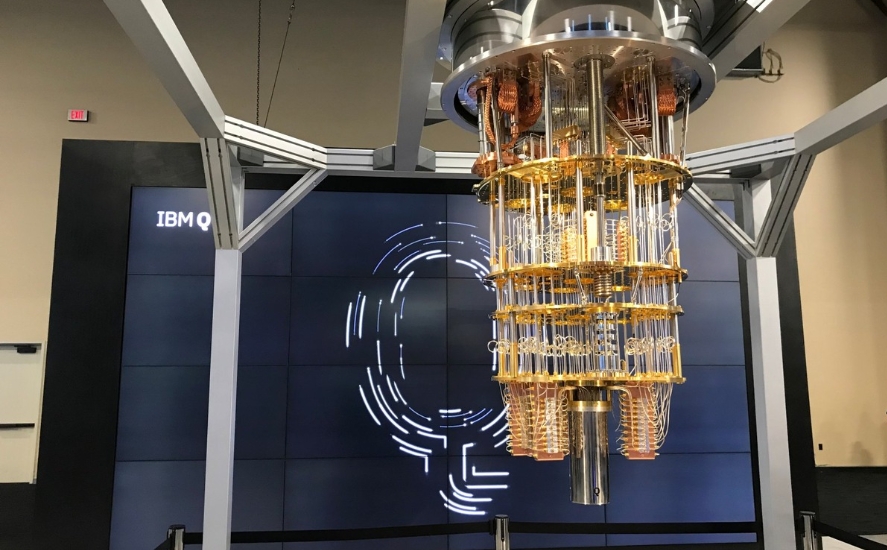
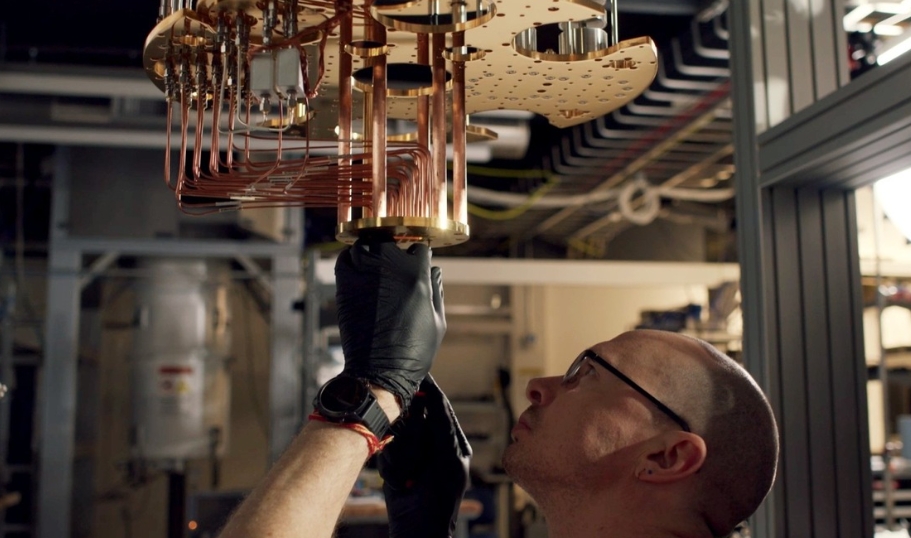
What does it look like? If you’ve ever seen pictures of quantum computers, you might have noticed strange, golden cylinders that resemble chandeliers. This is the supercooler—a complex cooling system that keeps the qubits running.
Electronic Control (for Controlling Qubits)
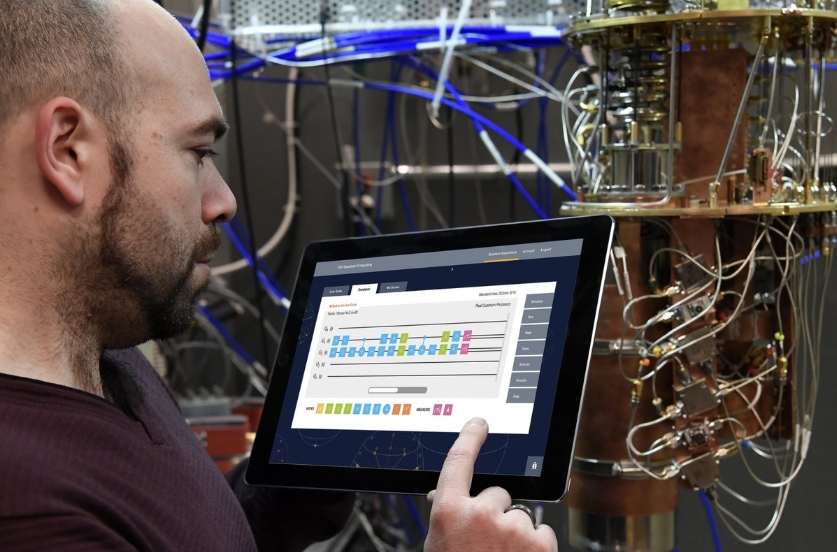
Qubits are volatile entities. To control them, you need special microwave signals that convert them from one state to another.
How does it work? In a conventional computer, the processor retrieves instructions from Random Access Memory (RAM), decodes them, and executes them, transmitting control and computation signals as electrical pulses through a system of data buses and control units. In a quantum computer, microwave pulses are used instead of electricity.
What’s the difficulty? The problem is that qubits are extremely sensitive. The slightest error or interference can disrupt all computations. Therefore, all this electronics must be extremely precise.
Important: Qubit control depends on the type of quantum processor. For example, optical qubits use light pulses to transmit and process information, while neutral qubits use laser pulses.
Error Correction Systems
If a regular computer makes a mistake, it can easily correct it (for example, by checking the data against backups).
What about a quantum computer? Quantum computers not only make mistakes, but they make them constantly. Even the slightest external influence (such as heat, radio waves, or vibrations) can corrupt the data.
How is this problem solved? Special algorithms are being developed to correct quantum errors and protect the qubits. However, this is still a complex task, which makes quantum computers unstable.
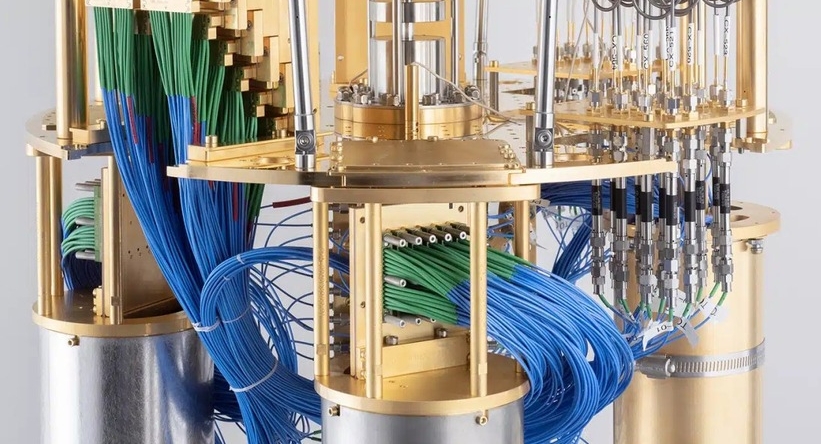
A huge cabinet filled with wires and servers
A quantum processor cannot work alone. It needs conventional computers to help it.
- Sending commands to qubits
- Processing the results of quantum computing
- Storing data
So, if you imagine a quantum computer, it would look like this:
- At the top is a quantum processor (a tiny chip).
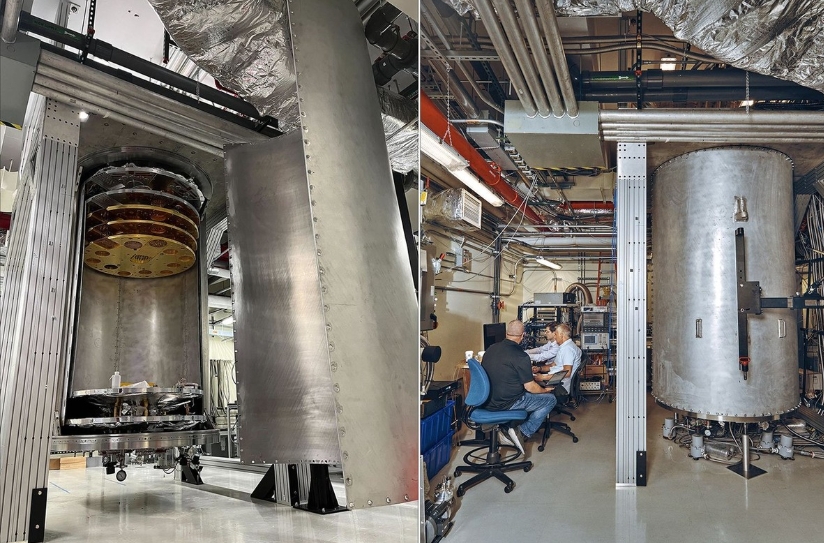
- In the middle is a giant refrigerator (a freezer).
- Below are cabinets containing electronics, wires, and servers.
All of this takes up an entire room.
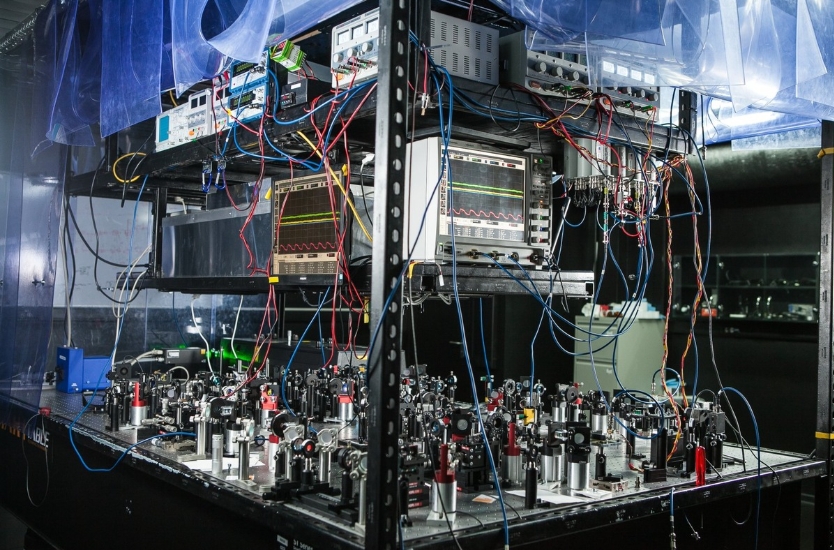
Important: For example, optical qubits do not have a huge cooling system, but they do have vacuum chambers and laser systems, which also take up a lot of space.
So, what do we have?
- A quantum processor is a chip containing qubits;
- A cooler is a refrigerator that cools the qubits to -273°C (in the case of superconducting qubits);
- Control electronics—microwave signals for control (in the case of superconducting qubits);
- An error correction system—to prevent data corruption;
- Regular computers and servers are used to process information.
Essentially, a quantum computer is not just a “computer,” but a complete scientific facility. It’s more like a giant laboratory than a regular laptop.
Traditional vs. Quantum Computers
To understand how a quantum computer differs from a traditional computer, let’s first understand how a regular computer works.
How does a regular computer work?
Imagine your computer as a librarian. It has shelves full of books (memory), a task list (processor), and a data storage system. But most importantly, it thinks in two states: 0 and 1. It’s like a light switch—either on (1) or off (0). These zeros and ones are called bits, and all the information in the computer is encoded using them.
How Does a Quantum Computer Work?
But a quantum computer isn’t just a librarian; it’s a true magician. It doesn’t work with bits, but with qubits (quantum bits). And that’s where the magic begins.
- Superposition – A qubit can be not just 0 or 1, but something in between. It’s like being awake and asleep at the same time. Or like a coin in mid-air – as it spins, its head and tail are simultaneously visible.
- Quantum entanglement – If you have two qubits, they can be linked so that any change in one instantly affects the other, even if they are kilometers apart. Imagine two meat pies in two different cities, but if you add potatoes to one, they magically appear in the other.
What’s the fundamental difference?
A regular PC performs calculations bit by bit. A quantum computer, however, processes all possibilities at once. It’s like a regular computer trying to find its way out of a maze, step by step, while a quantum computer simply navigates to the right place. In summary:
- A regular computer → thinks sequentially (1, 2, 3, 4…);
- A quantum computer → solves everything at once, like a genius who sees the answer instantly.
For this reason, quantum computers may one day be able to solve any problem that would take years to solve using traditional computers. But they are still under development.
How do quantum computers work?
Well, we already know that quantum computers use qubits instead of traditional bits (0 and 1). But why does this make them so powerful? Let’s look at some simple examples.
Qubits: The Magic of Superposition
Imagine you have a regular coin. If you flip it, it will land either on heads (1) or tails (0). That’s how regular coins work—there are only two possible outcomes.

But a quantum computer is like a coin; when tossed, it remains suspended in the air—it has both sides of the coin at once! This is known as quantum superposition. A qubit can be not only 0 or 1, but also something in between—both states simultaneously.

What does this mean? Imagine a human-like computer searching for the correct key in a set of 100 keys. It picks one, tries it, and it doesn’t match, then picks the next key, and so on until it finds the right one.
At this point, a quantum computer simply freezes into a superposition state and tries all the keys at once. This is why it can be many times faster!
Entanglement: When Qubits Communicate Telepathically
Imagine you have two magic dice. They are linked so that if you look at one and see a certain number, when you look at the other (even if it’s on the other side of the universe), you instantly know it will also show the corresponding number.
This is quantum entanglement. When two qubits become entangled, their states are inextricably linked. But it’s important to understand that entanglement doesn’t allow for the transfer of information; it only ensures that measuring the state of one qubit instantly determines the state of the other.
What does this mean? Quantum entanglement allows qubits to work in unison, which is crucial for quantum cryptography, error correction, and some quantum algorithms. However, quantum entanglement alone does not speed up quantum computing. Quantum superposition and finely designed algorithms that increase the probability of obtaining the desired result after measurement contribute to faster computation.
Note: Quantum computers do not give the correct answer immediately; instead, they make a guess, and the probability of getting the correct answer depends on the algorithm’s settings. When a qubit is measured, it randomly selects one of the possible states. But if the algorithm is well-designed, the chance of getting the desired answer increases.

Why might quantum computing be faster?
Imagine you’re trapped in a vast maze. Your goal is to find the way out, but you’re faced with numerous forks, dead ends, and tangled passages. What should you do?
A typical computer is like a human searching for a solution through trial and error. It takes one path, and if it hits a wall, it changes course and tries another. This all takes a long time.
A quantum computer is like a person who can be in every part of the maze at once! It doesn’t wander around the passages; it knows the way out instantly.
This is possible thanks to two properties of qubits that we discussed earlier:
- Superposition is the ability to exist in multiple states simultaneously;
- Entanglement is instantaneous communication between qubits.
Now let’s see where this speed can be truly useful.
Decrypting Complex Encryptions
In our modern world, information security relies on encryption. For example, bank cards, passwords, and sensitive data are protected using encryption. To decrypt a complex encryption, a typical computer would have to try billions of possibilities, a process that would take hundreds of years.
A quantum computer uses its immense power to calculate all possibilities simultaneously. It’s like trying to open a safe: a conventional computer would try entering one number at a time, while a quantum computer would instantly know the correct combination. This is why cryptographers are currently developing new methods to protect against quantum hacking.
Developing Drugs and Materials
Modeling molecules is a complex task, even for the most powerful supercomputers. For example, discovering a new drug is like assembling a giant jigsaw puzzle, where each piece interacts with thousands of others.
- A conventional computer cannot consider all the possibilities—it would have to test each combination of molecules one by one.
- A quantum computer can analyze all possible interactions at once and find the required combination much faster.
This is how they are already trying to find treatments for complex diseases, such as Alzheimer’s and cancer.
Artificial Intelligence and Big Data
Modern neural networks and artificial intelligence require enormous computing power. For example, training a chatbot or facial recognition system can take weeks or even months.
- Traditional computers process data sequentially, which slows down the process;
- Quantum computers can process massive amounts of information simultaneously, potentially speeding up AI training by hundreds of times.
This means that in the future, your voice assistant or chatbot could become much smarter and faster, and its data analysis could become much more accurate.
Why aren’t quantum computers in every home yet?
Because they are still highly volatile, complex, and unstable. While a regular computer is a convenient, reliable, and portable device that works in any weather, a quantum computer is like a supercar that moves at rocket speed, but only under ideal conditions.
They require extreme conditions.
For qubits to function, they must be cooled to near absolute zero (-273 degrees Celsius). That’s colder than space!
Imagine your smartphone freezing if you hold it for too long. Well, quantum computers are much more sensitive than that; the slightest change in temperature or even vibrations can crash the entire system. That’s why they must be kept in specialized laboratories with numerous safety features.
However, recent research has shown that some qubits can operate at much higher temperatures. For example, scientists at the University of New South Wales have developed qubits that operate at temperatures as low as -272°C, just one degree Celsius above absolute zero.
Note: Other types of qubits include:
- Neutral atoms and ion traps: These systems do not require the extreme temperatures of superconducting qubits, but they still require a vacuum, a precise laser, and a complex infrastructure;
- Optical qubits: These can operate at room temperature, but they require a complex optical system;
- Silicon spin qubits: These are closer to classical processors, but are still difficult to scale up.
They are extremely unstable.
Qubits easily lose their quantum state due to even the slightest disturbance: noise, heat, magnetic fields—and that’s it, calculations crash. This is called quantum decay.
Imagine memorizing all your exam papers at once. But then, as soon as you sneeze, the knowledge vanishes. Furthermore, quantum qubits easily “forget” information.
Scientists are already working on error correction methods, but stable quantum computing remains rare.
Programming them remains difficult.
Even if quantum computers suddenly become widely available, writing programs for them will be a nightmare for developers.
If you write code in Python, Java, or C++ for a regular computer, you need to use entirely new programming principles for a quantum computer.
Currently, large companies (Google, IBM, Microsoft) are creating special languages for quantum programming, but mastering them is not easy, even for professionals.

The basic idea is that quantum computers operate according to the principles of quantum mechanics (superposition, entanglement, interference). This is completely different from classical logic (bits, cycles, conditions).
IMB uses the Qiskit library (Python), Google uses the Cirq library (Python), and Microsoft already uses Q#, integrated with Visual Studio.
Winning Quotes For Successful Living – archely
Energy Work: Your Not-So-Secret Weapon – archely
It’s not universal.
A quantum computer won’t replace your laptop. It’s not designed for browsing the internet, editing videos, or playing games.
In fact, quantum computers are used only for very specific tasks, such as complex calculations, molecular modeling, and optimization. If a regular computer is like a versatile Swiss Army knife capable of doing almost anything, a quantum computer is like a giant laser machine that can only perform one task, but it does it incredibly fast.
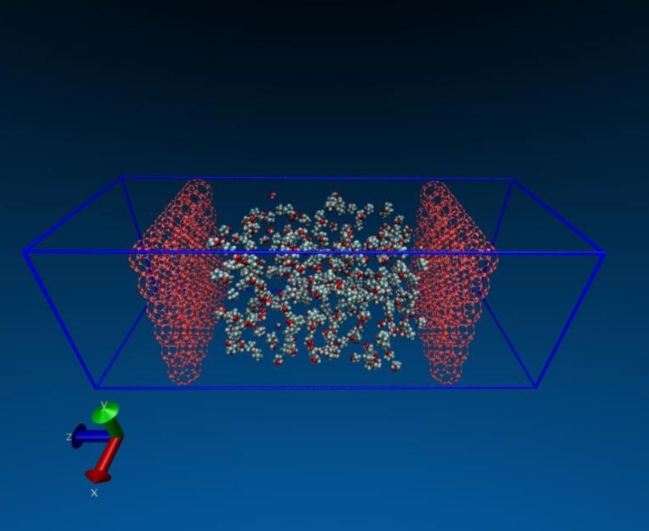
Predictions: When Can We Expect a Revolution in Quantum Mechanics?
The quantum computing revolution has already begun, but we won’t see its full impact for another ten to twenty years. Currently, quantum computers are similar to the first mainframe computers of the 1950s: they exist, but are still far from widespread adoption. In the coming years, we will see gradual progress: quantum devices will become more powerful, their first useful applications will appear, and programmers will learn to write more complex algorithms for them. But for quantum technologies to become part of our daily lives (like smartphones or the internet), we have to wait. So, for now, it’s like an exciting scientific experiment, slowly but surely changing the future.
In the meantime, don’t rush to throw away your computer. You’ll still need it.
Examples of Quantum Computers
Quantum computers are not just an idea; they already exist! While they are currently more of a scientific facility than a traditional personal computer, their development is underway all over the world. Let’s look at some real-world examples of quantum computers.
IBM’s first quantum system. IBM was one of the first companies to make quantum computers available to scientists worldwide. Its processors can now be tested online. One of the most recent is the Willow quantum processor, which has 105 qubits. This may seem like a small number, but remember that just 50 qubits can perform calculations that traditional supercomputers cannot. Before Willow, the Osprey processor, with 433 qubits, was also showcased. The question is: why is Willow more powerful than Osprey? The answer is that Google Quantum AI successfully implemented quantum error checking, allowing Willow to process tasks much more efficiently.
Google’s Sycamore quantum computer. This computer caused quite a stir in 2019 when Google announced it had performed a calculation that would take the most powerful supercomputers 10,000 years! Sycamore uses 53 qubits (which is not a large number), but thanks to quantum effects, it has proven its ability to solve some problems extremely quickly.
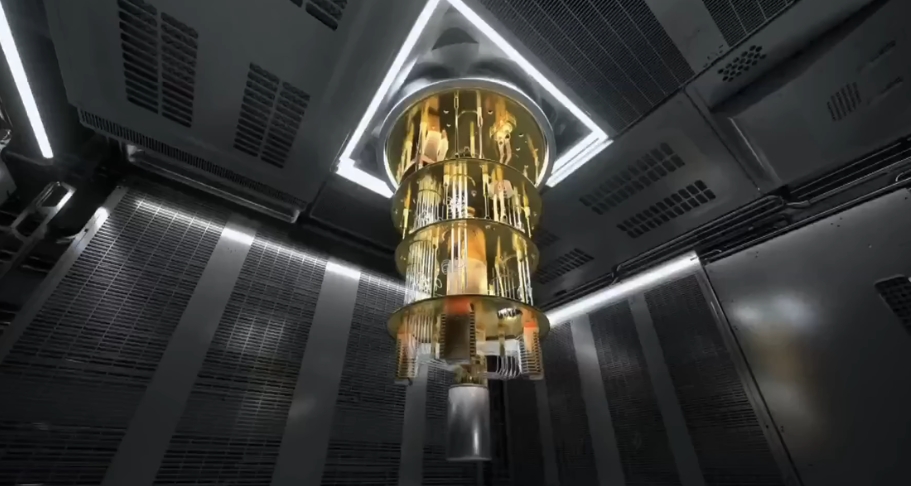
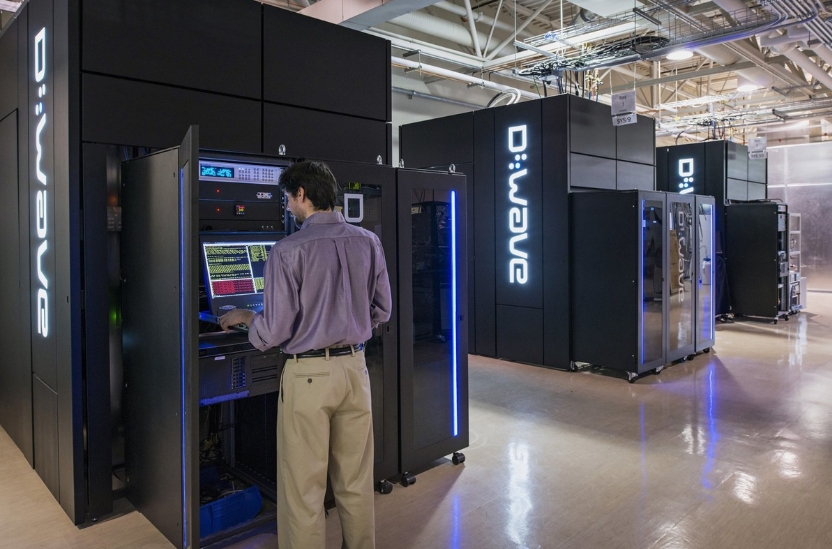
D-Wave. Unlike other companies, D-Wave doesn’t build general-purpose quantum computers, but rather highly specialized ones—used to optimize tasks, for example, in the logistics sector.
Quantum computers are also being developed in Russia. Scientists from Moscow State University and the Russian Center for Quantum Computing have created the country’s first prototype with a capacity of 50 qubits, which has already proven its functionality. This quantum computer uses rubidium atoms held together by special laser tweezers, with these atoms encoding quantum information. The system currently operates in the cloud, allowing remote access, which enables scientists to test algorithms and conduct experiments in quantum computing.
Although this is just a prototype, Russia is also moving toward quantum technologies. Scientists plan to upgrade the quantum computer to 75 qubits this year.
China is not sitting idly by either. In January 2024, the third-generation Benyuan and Kong superconducting quantum computer was launched in Hefei. It contains 198 qubits, making it one of the most powerful quantum computers in the world.
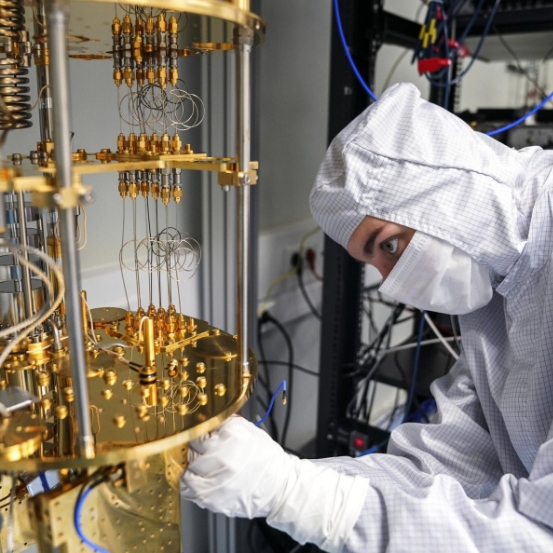
On October 25, 2024, the world’s largest hydrodynamic simulation (using a quantum computer to solve complex problems related to the movement of liquids or gases) was performed on it, and the results were published in an international scientific journal.
Conclusion
Quantum computers are amazing, but they are not yet accessible to everyone. They are already demonstrating their incredible capabilities in laboratories, but they are still far from widespread adoption.
When can we expect them to appear? It’s still unclear. Perhaps in 10-20 years they will become assistants to science, medicine, and business, but it’s unlikely they will be in every home.
Should you be worried? For the average user, no. Your laptop, smartphone, and gaming console won’t disappear. But cryptographers and scientists should keep a close eye on the situation.
So for now, you can relax, have a coffee, and follow the developments of the quantum future.
Quantum technologies – the future or science fiction? What do you think?