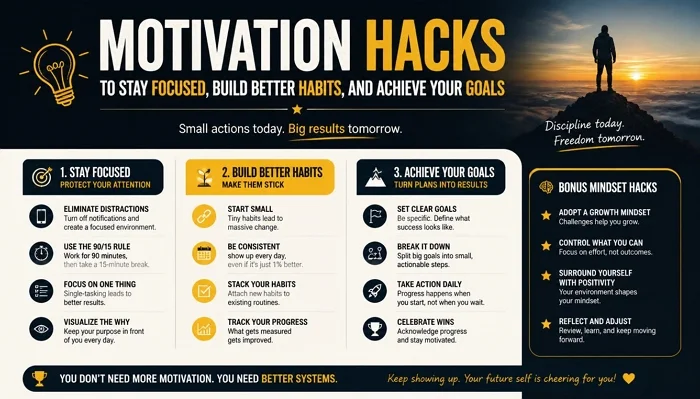
Have you ever looked back on your life and wished you had learned something important a little earlier? Many of us have experienced that feeling, especially when we realize how much time we spent struggling with goals that once seemed impossible.
One lesson worth learning early is that motivation can be a powerful force for personal growth. It can help you get things done, develop new skills, build healthier habits, and move closer to the future you want.
However, motivation is not always easy to maintain. Some days, you feel ready to conquer the world. On other days, even the simplest task feels exhausting. The secret is not to wait until you feel inspired again. It is to learn practical ways to encourage yourself, manage distractions, and keep moving forward even when enthusiasm fades.
The following motivation hacks combine inspiration, practical planning, accountability, and habit-building strategies to help you make progress toward your goals.
Motivation Hacks I Wish I Had Known Earlier
If I could travel back in time, I would give my younger self a simple piece of advice: stop waiting for the perfect moment to begin. Learn how motivation works, create an environment that supports your ambitions, and take small steps every day.
Here are 25 practical techniques that can help you do exactly that.
1. Find Inspiration in People Who Are Already Successful
If you struggle to develop a strong desire to succeed, spend time learning from people who have already achieved something you admire.
This is not about copying someone else’s life. It is about finding inspiration in their experiences, decisions, and lessons.
Read success stories, listen to interviews, explore question-and-answer sessions, and learn how accomplished people overcame obstacles. You may discover approaches that you had never considered before.
Inspiration can remind you that your goals are possible, even when the journey seems difficult. Use other people’s achievements as encouragement to develop your own path.
2. Build Deep Knowledge of Your Chosen Field
Motivation becomes more meaningful when it is supported by knowledge.
Reading books, studying useful resources, and learning from experienced professionals can help you understand your field beyond the basics. Instead of simply knowing what to do, you begin to understand why certain approaches work and how to apply them effectively.
Knowledge can improve your skills, strengthen your confidence, and help you make better decisions.
Choose a subject that matters to your goals and explore it in depth. Take notes, practice what you learn, and return to difficult concepts until they become clearer.
The more capable you become, the easier it can be to recognize opportunities and make steady progress.
3. Aim High, but Focus on What You Can Control
Ambitious goals can inspire you to think beyond your current circumstances. If you only aim for what feels comfortable today, you may never discover what you could accomplish with time and effort.
Dream about the possibilities, but remember that progress requires practical action.
You do not need to achieve everything immediately. You need a clear direction, realistic milestones, and a willingness to learn along the way.
Set a challenging long-term goal, then identify the next action that will bring you closer to it. This allows you to maintain a big vision without becoming overwhelmed by the distance between where you are and where you want to be.
4. Break Big Goals Into Small Steps
One of the most effective self-motivation techniques is to make your goals smaller and easier to start.
A major project can feel intimidating when you look at the entire workload. Writing a book, starting a business, improving your fitness, or learning a language may seem like enormous challenges.
Instead of trying to accomplish everything at once, divide the goal into manageable tasks.
For example, if you want to develop a regular writing habit, begin with 100 words a day. If you want to exercise consistently, start with a short workout that fits your current ability.
Small actions reduce the pressure of getting started. Over time, those actions can develop into habits that support much larger achievements.
5. Track Your Progress and Celebrate Improvement
Motivation often grows when you can see evidence that your efforts are making a difference.
Keep a simple record of what you accomplish each day. You can use a calendar, notebook, spreadsheet, or habit-tracking app to monitor your progress.
Record completed workouts, pages written, lessons studied, or tasks finished. Reviewing these achievements can help you recognize how far you have come, even when progress feels slow.
This creates a positive cycle: you take action, notice the result, gain confidence, and become more willing to continue.
Do not measure your success only by how far you still have to go. Pay attention to the progress you have already made.
6. Share Your Goals With Someone You Trust
Talking about your goals can create a useful sense of accountability.
When you tell a trusted friend, colleague, or mentor what you intend to accomplish, you create an opportunity to discuss your progress and receive encouragement. Knowing that someone will ask how things are going may help you stay focused.
However, announcing every ambition publicly is not always necessary. Some people work better when they keep their goals private and concentrate on the process.
Choose an accountability approach that genuinely helps you take action. The purpose is not to impress other people or feel ashamed when things go wrong. It is to create a support system that makes consistency easier.
7. Spend Time With People Who Reflect Your Aspirations
The people around you can influence your habits, attitudes, and expectations.
If you want to become a better writer, learn from writers. If you want to improve your business skills, spend time with people who understand entrepreneurship. If you want to develop a healthier lifestyle, connect with people who value consistent exercise and balanced routines.
You do not need access to celebrities or famous role models. Look for people in your community who demonstrate the qualities you want to develop.
Their experiences may offer practical lessons that are difficult to discover on your own.
At the same time, choose relationships that encourage mutual growth rather than constant comparison. The goal is to learn from others, not to feel inferior to them.
8. Consider the Cost of Doing Nothing
Sometimes, motivation comes from understanding what may happen if you continue postponing an important goal.
Imagine that another year passes without making progress. Would you still be struggling with the same problem? Would you regret not developing a useful skill, improving your health, or pursuing an opportunity?
Thinking about these possibilities can help clarify why your goal matters.
However, avoid using fear to criticize yourself or create unnecessary anxiety. The purpose of this exercise is to recognize the consequences of inaction and make a conscious decision to change direction.
Ask yourself: What is one thing I can do today to make my future easier?
Then take that step.
9. Visualize the Future You Want to Create
Visualization can help you connect your daily actions with your long-term ambitions.
Take a few minutes to imagine yourself making progress toward a meaningful goal. Picture the skills you are developing, the challenges you are learning to handle, and the satisfaction of completing important milestones.
You can also imagine the process itself. See yourself sitting down to study, completing a workout, preparing for an important meeting, or continuing a project when it becomes difficult.
This makes visualization more practical because it connects the desired outcome with the behavior required to achieve it.
Think about where you would like to be in two, five, or ten years. Then identify the habits and decisions that could help you move in that direction.
10. Connect Your Goals With Compassion and Purpose
Emotions can influence our willingness to take action. Feelings of compassion, gratitude, and concern for others can sometimes inspire us to contribute more meaningfully to the world.
For example, learning about people facing poverty, hunger, or limited access to education may encourage you to volunteer, donate responsibly, or develop a project that addresses a real need.
Instead of simply feeling upset about what you see, ask yourself what constructive action you can take.
You do not need to solve every problem. Even a small contribution can be worthwhile when it is consistent and genuinely helpful.
Connecting your ambitions with a sense of purpose can make your efforts feel more meaningful than pursuing achievements for recognition alone.
11. Use Deadlines to Create a Sense of Urgency
Without a deadline, an important task can remain on your to-do list indefinitely.
A clear deadline helps you decide when to begin, how much time to allocate, and which distractions to avoid.
For example, if you need to finish an assignment in two weeks, divide the work into smaller milestones and assign a date to each one.
You can also use personal deadlines for goals that do not have an external due date.
Make these deadlines challenging enough to encourage progress but realistic enough to avoid unnecessary pressure. If circumstances change, adjust the plan rather than treating every delay as a personal failure.
A useful deadline should encourage action, not punish you for being human.
12. Join a Competition or Find an Accountability Group
Friendly competition can encourage you to improve your performance and remain consistent.
Look for a writing challenge, fitness event, learning community, or professional group related to your interests. Working alongside others can introduce new ideas and give you a reason to keep showing up.
If a formal competition is not available, create a small group with people who share similar goals.
Each person can set weekly targets and report their progress. Members can exchange advice, celebrate achievements, and help one another overcome obstacles.
Competition is most useful when it encourages personal improvement. Measure your progress against your previous performance, too, rather than assuming that someone else’s success diminishes your own.
13. Create Financial Accountability Without Risking Your Well-Being
Money can sometimes provide an additional incentive to follow through on a commitment.
For example, you might agree with a trusted friend to donate a small, affordable amount to a cause you do not usually support if you miss a specific, reasonable target without a valid explanation.
Another option is to reward yourself financially for completing milestones, such as finishing a course or maintaining a study routine for a month.
Keep any arrangement voluntary, affordable, and free from humiliation or harmful consequences. Never risk money needed for food, housing, healthcare, or other essential expenses.
Financial accountability should support your goals, not create additional stress.
14. Make Thoughtful Sacrifices for Your Priorities
Meaningful goals often require you to give something up.
You may need to spend less time scrolling through social media, reduce unnecessary late-night activities, or decline invitations when you have an important deadline approaching.
These decisions can create more time and energy for the things that matter to you.
However, pursuing success does not mean eliminating rest, relationships, or enjoyable experiences from your life. Rest and social connection can support your long-term performance.
The key is to distinguish between activities that genuinely help you recharge and habits that repeatedly prevent you from following through on your priorities.
Choose your sacrifices carefully and make sure they support a life you actually want to live.
15. Reassess Your Goals and Understand Your Purpose
Motivation is not only about pushing harder. Sometimes, it is about checking whether you are moving in the right direction.
Take time regularly to reflect on what you are doing and why you are doing it.
Are your current goals connected to your values? Are you pursuing something because it matters to you, or because you feel pressured to meet other people’s expectations?
Our interests and circumstances change. A goal that once seemed essential may no longer fit the person we are becoming.
Review your priorities, recognize what you have learned, and adjust your direction when necessary.
Changing a goal after careful reflection is not automatically a failure. It can be a sign that you understand yourself better.
16. Keep a Powerful Motivational Quote Where You Can See It
Sometimes, a short message can remind you of something important when your motivation begins to fade.
Find a quote, personal statement, or meaningful reminder that reflects your values. Place it somewhere you will see it regularly, such as your desk, notebook, or phone wallpaper.
The message does not need to be famous or complicated. It could be as simple as:
Start before you feel ready.
Or:
Small progress is still progress.
A motivational quote will not complete your work for you, but it can serve as a useful prompt to take the next step.
Choose a message that encourages action rather than one that makes you feel guilty for struggling.
17. Identify and Remove the Barriers That Make Tasks Difficult
When you repeatedly avoid a task, ask yourself what makes it difficult to begin.
The problem may not be a lack of motivation. It could be an unclear plan, an overwhelming workload, a distracting environment, or insufficient energy.
Once you understand the barrier, you can choose a practical solution.
- If the task feels too difficult, divide it into smaller steps.
- If you keep getting distracted, silence notifications and put your phone away.
- If you feel overwhelmed, choose one priority instead of trying to do everything.
- If you are exhausted, consider whether you need rest or a more realistic schedule.
- If the goal no longer feels meaningful, revisit your reasons for pursuing it.
The principle is simple: do not rely on willpower alone when you can make the task easier to complete.
18. Learn to Say No to Distractions
Protecting your time sometimes means declining invitations and opportunities that conflict with your priorities.
Perhaps a friend invites you out when you have an important project to finish. Maybe you sit down to work but find yourself repeatedly checking social media.
You do not have to reject every social invitation or remove all entertainment from your life. Instead, make deliberate decisions about when to work and when to relax.
Try preparing a polite response in advance, such as, “I can’t make it tonight, but I’d love to catch up another day.”
You can also schedule leisure time so that it does not continually interrupt important tasks.
Learning to say no is not about avoiding people. It is about making room for the commitments you have chosen.
19. Find a Coach, Teacher, or Mentor
Learning from someone with more experience can help you avoid common mistakes and develop your skills more efficiently.
A mentor may offer feedback, practical guidance, and a perspective you would not gain by working alone. A teacher can explain difficult concepts, while a coach may help you establish goals and monitor progress.
You do not necessarily need an expensive professional service. Depending on your goal, you might find useful guidance through a local community, professional association, educational program, or trusted colleague.
Be open to feedback, ask thoughtful questions, and apply what you learn.
The best mentor is not simply someone you admire. It is someone whose experience and advice can help you make better decisions.
20. Prepare for the Moments When Your Motivation Drops
You probably already know some of the situations in which you tend to lose focus.
Perhaps you procrastinate when a project becomes complicated, abandon your exercise routine when work gets busy, or spend too much time online when you feel tired.
Instead of waiting for these situations to happen, prepare for them in advance.
Create a simple backup plan for predictable obstacles.
For example:
- If you feel overwhelmed, work on the smallest useful part of the task.
- If your schedule becomes busy, use a shorter version of your usual routine.
- If you miss a session, decide when you will resume.
- If distractions increase, move to a quieter environment.
You cannot predict every difficulty, but you can reduce the number of decisions you need to make when things become challenging.
21. Set Realistic Rules and Allow Flexibility
Strict rules can sometimes help you establish consistency, but overly rigid expectations can make it harder to recover from setbacks.
Suppose you are trying to exercise regularly. Missing one workout does not mean you have failed. What matters is how you respond afterward.
You might decide not to miss two scheduled workouts in a row. If you are tired, you could choose a lighter activity instead of abandoning the habit entirely.
If you are writing regularly, you could aim for a small daily target while allowing yourself to adjust it during unusually busy periods.
Create rules that support consistency without ignoring your circumstances.
Flexibility is not the opposite of discipline. When used thoughtfully, it helps you maintain your commitments over the long term.
22. Save Your Enthusiasm by Turning Ideas Into a Plan
Have you ever had a brilliant idea late at night and felt an overwhelming urge to work on it immediately?
Excitement can be useful, but it does not always last. Starting too many projects at once can leave you exhausted before you make meaningful progress on any of them.
When inspiration strikes, capture the idea in a notebook or digital document. Write down what excites you about it and identify the first practical step.
Then decide when you will return to it.
This approach allows you to preserve your enthusiasm without sacrificing sleep or abandoning existing commitments.
Rather than trying to complete everything while you feel inspired, build a system that helps you turn exciting ideas into consistent action.
23. Change Your Environment to Make Focus Easier
Your surroundings can influence how easily you concentrate.
If you repeatedly struggle to work at home, try a library, quiet café, or another suitable workspace. If your phone interrupts your attention, leave it in another room while completing important tasks.
You can also reduce digital distractions by disabling unnecessary notifications, setting app limits, or blocking access to distracting websites during focused work sessions.
The objective is not to make your life unnecessarily difficult. It is to remove the easiest routes to distraction and make productive behavior more convenient.
A supportive environment reduces the number of times you must rely on willpower.
24. Match Your Daily Actions to the Person You Want to Become
Your mindset can influence the choices you make, but confidence alone is not enough to achieve a goal.
If you want to become a skilled writer, begin developing the habits of a writer. If you want to become healthier, build routines that support your well-being. If you want to become a capable leader, practice communication, responsibility, and thoughtful decision-making.
Ask yourself what the person you want to become would do today.
Then choose one action that reflects that identity.
Avoid using negative self-talk when you make mistakes. Instead of saying, “I’m terrible at this,” try, “I’m still learning, and I can improve with practice.”
Confidence becomes more sustainable when it grows from repeated effort and real experience.
25. Be Authentic and Focus on What Matters to You
It is easy to become distracted by other people’s expectations of success.
You may feel pressure to pursue a particular career, earn a certain amount of money, or follow a lifestyle that looks impressive from the outside.
But a goal that makes someone else happy may not be right for you.
Take time to identify your values, interests, strengths, and priorities. Consider what a meaningful life would look like on your own terms.
You can learn from other people without allowing them to make every important decision for you.
Be willing to pursue what you believe is worthwhile, even when your choices differ from the crowd. At the same time, remain open to constructive criticism and new information.
Authenticity is not about assuming you are always right. It is about making thoughtful choices that reflect your values while continuing to learn and grow.
How to Stay Motivated When You Don’t Feel Like Doing Anything
Even with these strategies, there will be days when motivation is low. That is a normal part of pursuing long-term goals.
Instead of waiting for your enthusiasm to return, try this simple process:
Start With One Small Action
Choose a task that takes five minutes or less. Open the document, prepare your workout clothes, read one page, or write the first sentence.
The purpose is to overcome the initial resistance and make starting easier.
Remove One Distraction
Put your phone away, close unnecessary browser tabs, or move to a quieter place. A small environmental change can make it easier to concentrate.
Focus on the Process, Not Just the Result
Long-term goals often take months or years to achieve. Concentrate on the actions you can control today rather than judging yourself by how quickly you reach the final destination.
Review Your Progress Without Criticizing Yourself
At the end of the day, identify what went well and what you could improve tomorrow. Treat setbacks as information that can help you refine your approach.
Remember That Rest Is Part of Progress
If you are consistently exhausted, struggling to concentrate, or feeling overwhelmed, consider whether you need more rest or a lighter workload.
Productivity is not about pushing yourself relentlessly. Sustainable progress requires balancing effort with recovery.
Final Thoughts: Turn Motivation Into Consistent Action
Motivation can help you begin, but lasting progress usually depends on the systems, habits, and decisions that support you along the way.
You do not need to apply all 25 motivation hacks at once. Choose two or three that address your biggest challenges, put them into practice, and evaluate what works for you.
Learn from people you admire, break ambitious goals into smaller steps, track your progress, and make your environment support your priorities. When you encounter setbacks, adjust your approach instead of assuming that one difficult day has erased your progress.
Most importantly, remember that you do not have to feel motivated every day to keep moving forward.
Start small, stay flexible, and keep taking meaningful steps toward the life you want to build.
References:
- American Psychological Association (APA): What You Need to Know About Willpower (Explains self-control, goal setting, progress monitoring, and strategies for resisting distractions and maintaining productive behaviors.)
- Annual Review of Psychology: Psychology of Planning (Reviews research on planning, motivation, and practical if-then strategies that can help people translate intentions into action.)
- Association for Psychological Science (APS): Habits, Goals, and Effective Behavior Change (Explores how habits develop, why environments influence behavior, and how changing routines and surroundings can support lasting behavioral change.)
- American Psychological Association (APA): Setting Specific Goals Improves Cognitive Effort, Self-Efficacy, and Sustained Attention (Research examining how specific goals influence attention, cognitive effort, and performance.)
- Journal of Personality and Social Psychology: Attaining Personal Goals: Self-Concordance Plus Implementation Intentions Equals Success (Examines the relationship between personally meaningful goals, action planning, and progress toward achieving objectives.)