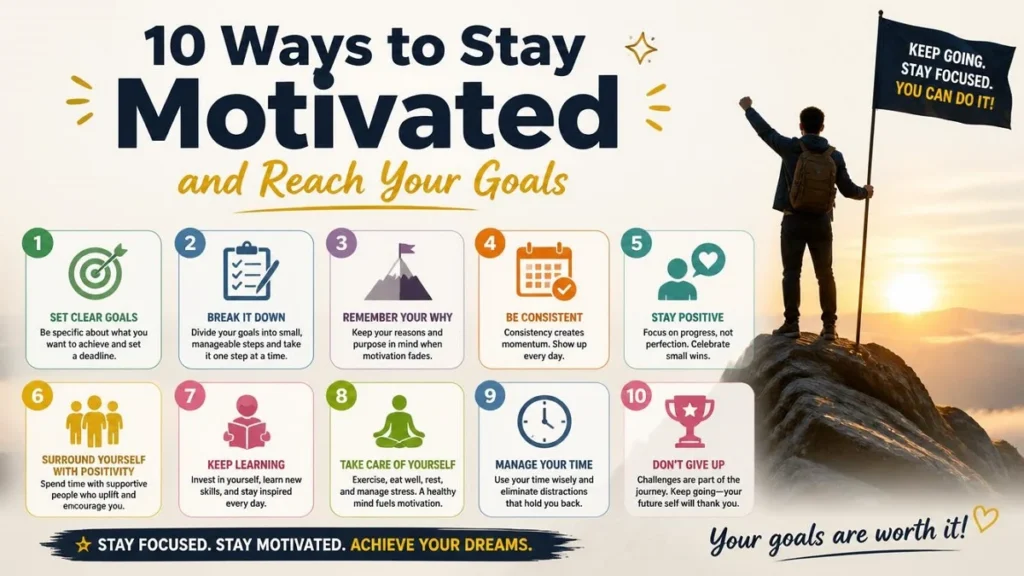
Staying motivated does not mean feeling inspired every day. Some days, progress feels exciting; on other days, even a small task can seem difficult. The difference often comes from how you respond when your plans change, your energy drops, or the results take longer than expected.
The good news is that motivation can be supported by practical habits. By protecting your focus, measuring progress realistically, and taking care of your health, you can make it easier to keep moving toward your goals—even when the path is not as smooth as you expected.
Quick takeaway: Motivation becomes easier to maintain when you set clear goals, protect your energy, track small wins, and stay flexible when circumstances change.
Here are 10 practical ways to stay motivated and reach your goals without losing yourself in the process.
1. Stay Flexible When Your Plans Change
A goal gives you direction, but your original plan is not a contract. Unexpected problems, financial pressure, changing responsibilities, or a simple lack of time can force you to adjust your approach. That does not mean you have failed. It means you are responding to reality.
Instead of asking, “Why is this not working?” try asking, “What can I change while keeping the same overall goal?” You may need to change the deadline, reduce the size of the next step, or find a different way to make progress.
Flexibility is especially important when you are working toward a professional or financial goal. For example, developing a side income, learning a new skill, or offering a small freelance service may help you create more options without abandoning your main direction. The goal is not to do everything at once. It is to build a plan that can survive change.
2. Limit the Noise Around You
It is difficult to stay motivated when your attention is constantly being pulled in different directions. News updates, social media arguments, notifications, and other forms of digital noise can leave you mentally tired before you begin your most important work.
This does not mean ignoring the world or pretending that difficult events do not exist. It means deciding when and how you will consume information. Try checking the news at a specific time instead of following every update throughout the day. Turn off unnecessary notifications and create short periods when your phone is out of reach.
Protecting your attention gives you more room to think clearly. It also helps you focus on the actions you can control instead of spending all your energy reacting to events you cannot change.
3. Look for Opportunities in Difficult Situations
Setbacks can make the future look smaller than it really is. When one plan stops working, however, it may be time to look for another route rather than assuming that every route is closed.
A difficult situation can reveal a skill you need to develop, a problem people need help solving, or an option you had not previously considered. If your current work is slowing down, for example, you might explore a related service, improve an existing skill, or speak with people who understand the situation better.
This is not about pretending that every problem is positive. Some setbacks are genuinely painful and require time to handle. The useful question is simply: “Given the situation I am in, what is the next available opportunity?” That question can help you move from helplessness to action.
4. Measure Progress Against Reality, Not Perfection
Comparing your current results with an ideal version of your life can quickly destroy your motivation. You may also compare yourself with people who have different resources, responsibilities, experience, or starting points.
A better approach is to measure progress against a realistic standard. Compare your current results with where you were last month, last quarter, or at the beginning of the year. You can also compare your performance with similar situations rather than with an unrealistic image of success.
Clear goals and regular feedback can make it easier to direct your attention and evaluate progress. This is consistent with established goal-setting research, which emphasizes the value of clear goals, commitment, and feedback in supporting performance Locke and Latham, 2002.
At the end of each week, write down three things: what you completed, what slowed you down, and what you will change next week. Small evidence of progress is often more motivating than waiting for one dramatic success.
5. Use Your Strengths to Stand Out
One way to stay motivated at work is to connect your daily responsibilities with the strengths you want to develop. If you work for someone else, look for practical ways to improve a process, solve a recurring problem, or make the customer experience better. Then communicate your ideas through your actions and your results.
If you work independently, the same principle applies. Identify what you do particularly well and make it part of your offer. Your ability to explain complex ideas, organize details, respond quickly, or understand customers may become an important advantage.
This is not about proving that you are better than everyone around you. It is about recognizing your value and using it deliberately. Feeling capable can strengthen your motivation because you can see a connection between your effort and your growing competence.
6. Focus on What Is Still Going Well
Positive thinking does not require you to deny your problems. It means noticing the parts of your life that are still working while you deal honestly with the parts that need attention.
When someone asks how things are going, you do not have to pretend that everything is perfect. You can acknowledge the challenge and still mention something you appreciate: a supportive person, a useful opportunity, a skill you are learning, or a small improvement you have made.
This habit changes the way you look at your circumstances. Instead of allowing one problem to define the entire day, you create a more balanced view. That balance can make it easier to continue taking constructive action.
7. Simplify Your Life and Your Priorities
Sometimes a lack of motivation is really a lack of clarity. When every task feels urgent, it becomes difficult to know where to begin. Simplifying your schedule and environment can give your attention a clear direction.
Start by choosing one or two priorities for the day. Remove tasks that are not necessary, group similar activities together, and prepare your workspace before you begin. You can also review recurring expenses, commitments, and digital distractions that consume time without supporting your goals.
A simpler routine does not have to be boring. It can create more space for the people, projects, and activities that matter most. When your plan is realistic, you are more likely to follow it consistently.
8. Help Others While You Work Toward Your Goals
Working toward a personal goal can become exhausting when all your attention is focused on your own results. Helping someone else can restore a sense of meaning and connection.
You might share useful knowledge, support a colleague, volunteer your time, or simply listen to someone who is having a difficult day. The value of helping others should not depend on what you receive in return. At the same time, positive social connections can make challenges feel less isolating.
Support from other people also matters when you are trying to maintain motivation. Tell someone you trust what you are working toward, ask for constructive feedback, or join a group with similar interests. Motivation is easier to sustain when you do not feel that you are carrying everything alone.
9. Protect Your Energy With Healthy Habits
Your body and mind are part of your goal-setting system. If you consistently sleep too little, remain inactive, and rely on irregular meals, even a meaningful goal can start to feel impossible.
The Centers for Disease Control and Prevention notes that adults between 18 and 60 generally need at least seven hours of sleep, and that adequate sleep supports mood, attention, and memory CDC, 2024. The World Health Organization also reports that regular physical activity can improve mental well-being, reduce symptoms of depression and anxiety, and support overall health WHO, 2024.
You do not need a perfect health routine to begin. Try going to bed at a more consistent time, taking a daily walk, drinking more water, or preparing one balanced meal. Small improvements in energy can make it easier to concentrate and follow through.
10. Prepare for Better Opportunities
When progress is slow, it is tempting to wait for circumstances to improve before doing anything. A more useful approach is to prepare while you wait.
Use quiet periods to learn a relevant skill, update your portfolio, organize your finances, improve your professional network, or complete a task that you have been postponing. You may not be able to predict exactly when the next opportunity will appear, but you can increase your ability to recognize and use it.
Preparation also makes change less frightening. A successful person is not someone who avoids every setback. It is someone who can adapt, learn, and keep moving when the situation changes.
How to Stay Motivated When You Lose Momentum
Make the next step smaller
When a goal feels overwhelming, reduce it to an action that takes 10 or 15 minutes. Open the document, make the call, read two pages, or write the first paragraph. Starting is often easier when the task is specific and limited.
Remember why the goal matters
Motivation is usually stronger when a goal feels personally meaningful rather than driven entirely by outside pressure. The American Psychological Association’s overview of self-determination theory explains that motivation is supported by autonomy, competence, and connection with others APA, 2025. Ask yourself why this goal matters to you and what kind of person you want to become while pursuing it.
Review your progress regularly
Do not wait until the end of the year to decide whether you are moving forward. A short weekly review can show you what is working, what needs to change, and which small wins deserve recognition.
Frequently Asked Questions
How can I stay motivated every day?
You can support daily motivation by setting one or two clear priorities, creating a realistic routine, and focusing on consistent progress rather than waiting to feel inspired. Your motivation may change from day to day, but a simple system can help you keep taking action.
What should I do when I lose motivation?
Take a short pause and identify what is making the goal difficult. The problem may be an unclear next step, an unrealistic deadline, fatigue, or a goal that no longer reflects what you want. Reduce the next action until it feels manageable, then restart with that small step.
How long does it take to reach a goal?
The answer depends on the type of goal, your starting point, your available resources, and the consistency of your actions. Instead of focusing only on the final deadline, track the habits and milestones that move you forward.
Final Thoughts
Staying motivated is not about being positive every minute or avoiding every difficult period. It is about building enough clarity, flexibility, and support to continue when enthusiasm fades.
Set a direction, make the next step manageable, protect your energy, and review your progress honestly. If your original plan stops working, adjust it rather than abandoning the goal completely. Progress may not always be fast, but consistent action can still take you closer to the life you want to build.
What helps you stay motivated when progress feels slow? Share your experience in the comments.

1 Comment