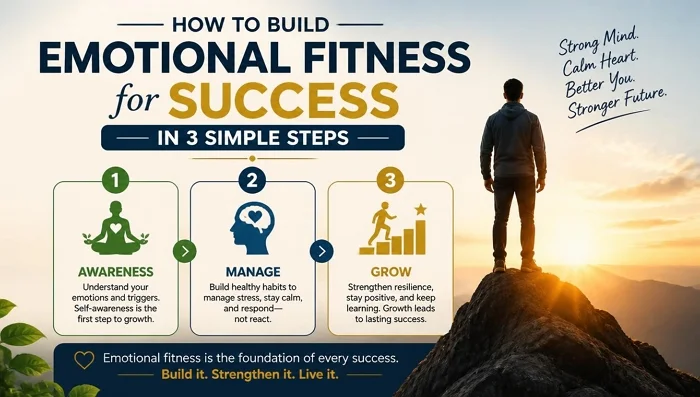
In my line of work, so many people I meet are enslaved by their emotional fitness reality. One minute they’re happy, the next they’re stressed, and the next they’re angry! When speaking to people during one of these sudden changes of emotional state, I notice they will often over-generalize their situations.
For example, imagine going for a job interview and not being chosen. In that moment, it’s easy to take the news personally and interpret it as a total rejection. An emotional explanation of this event often sounds something like, “This always happens to me,” or “I’m never going to get a new job.”
When this happens, your resilience to pick yourself up and go for another interview is significantly reduced. You continue to over-generalize, remembering past failures, which only reinforces your negative beliefs. This damaging cycle is applicable in all areas of life—whether in romantic relationships, friendships, or your career.
So, what is really happening here? People give their emotions free reign, allowing feelings to completely overwhelm their sense of logic. Feelings of disappointment quickly turn into feelings of inadequacy and fear, leading to a generalization of their whole experience: “This is just my life story!”
But here’s the breakthrough truth: you are not your emotions. If you want to know how to build emotional fitness and prevent these moments from controlling your destiny, you must train your mind.
Step 1: Stop Over-Generalizing
First, you have to stop making a single bad moment define your entire life experience. Life doesn’t always go according to plan, but you must consciously choose to see these setbacks for what they really are: temporary and momentary.
When a crisis hits, practice these two sub-steps:
1. Freeze Your Reaction
Before you spiral into negative thoughts, pause. Take a deep breath and remind yourself that you have the ultimate power to choose how you want to react and feel. It isn’t easy, but it is completely possible with practice.
2. Separate Your Identity from the Event
Failures are events, not identities. Missing out on an opportunity doesn’t make you a failure; it simply means that specific path wasn’t the right one at that specific time.
Ready to Level Up? Explore More Insights for a Balanced Life:
3 Simple Steps on How to Improve Your Life Quality Starting Today
Step 2: Choose a Wise Confidant (The Power of a Mentor)
You cannot build high-level emotional fitness in isolation. You need to choose a person who possesses wisdom, insight, and someone who will naturally energize and inspire you.
As a professional recommendation, I would not advise going to your immediate peer group or close friends for strategic emotional coaching. Instead, I highly recommend investing in a professional coach or mentor.
Why a Neutral Mentor Changes Everything
A coach or mentor does not have an emotional connection to you the way a friend or family member does. This absolute neutrality means they can analyze your situation from a strategic, bird’s-eye perspective rather than an emotional one.
When choosing a mentor, look for someone who achieves the level of mastery that you aspire to have in your own life.
Even as a coach myself, I have my own mentor. This relationship continually stretches me and refines my emotional fitness. I remember a time when I felt I had really let myself down, and I was beating myself up mentally. Within just 30 minutes of speaking with my mentor, he helped me see the situation from a completely different perspective. He reassured me that although my choices weren’t the best, they by no means tarnished who I was as a person.
Remember, we are social beings. We need each other’s unique opinions and life experiences to learn, grow, and live life to the fullest. Investing in a mentor is the ultimate investment in yourself.
Don’t Stop Here! Keep Improving Your Mindset and Workflow:
Step 3: Refuel Your Resilience Daily
Resilience is like a muscle—it weakens if neglected but grows stronger with intentional training. To refuel your resilience, you must consciously shift your focus from what went wrong to what went right.
Start by looking back at the difficult events you have successfully overcome in the past. By doing this, you will discover a profound truth: when it really matters, and when everything is on the line, your inner emotional strength always comes through.
How to Shift Your Emotional State:
- Stop dwelling on negative loops: Actively interrupt thoughts that remind you of past failures.
- Focus on your success stories: Keep a mental (or written) journal of the times you won, persevered, or survived.
- Recapture the feeling: Re-visiting successful moments will re-inspire self-belief and instantly shift your emotional state from negative to positive.
Recommended Reading: Handpicked Articles for You
Conclusion: It’s Not Over Until You Say So
To finish, I want to share an incredible, true story of a woman who developed her emotional fitness to an extraordinary level. She failed her driving test 39 times. Most people would have quit after the fifth or tenth attempt, labeling themselves “unfit to drive.”
However, after consciously reconditioning her emotional state and refusing to let those moments define her, she gave everything she had and passed her driving test on her 40th attempt
Remember, no matter what happens in any single moment, this is not your whole story. Your journey toward success is a marathon, and it is never truly over until you say so. Take control of your emotions today, build your emotional fitness, and watch your reality transform.
References / Suggested Reading
- Visual Guide: Productivity Is A Full-Body Exercise: GPP & GWP Workflow Infographic
- Harvard Business Review: Building Psychological Resilience and Mental Strength – Authoritative strategies and research-backed frameworks on overcoming professional setbacks.
- Psychology Today: Understanding Cognitive Distortions and Overgeneralization – Clinical insights into breaking the negative thinking loops that drain your mental energy.
1 Comment