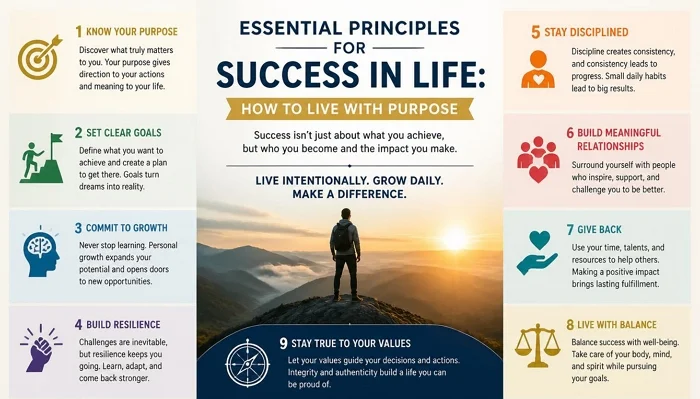
Success is about much more than money, professional achievements, or reaching a particular milestone by a certain age. True success comes from knowing what matters to you, making meaningful choices, and building a life that reflects your values and aspirations.
Without clear goals and guiding principles, it is easy to spend years moving from one responsibility to another without feeling that you are making real progress. The good news is that you do not need to have everything figured out to begin living with purpose. You simply need a willingness to learn, take action, and keep moving forward.
The following 11 principles for success in life offer practical inspiration for developing a positive mindset, building stronger relationships, overcoming challenges, and creating a legacy that extends beyond personal achievements.
1. Focus on Health, Wealth, and Personal Well-Being
Success means different things to different people, but it becomes difficult to enjoy any achievement when your health, peace of mind, or personal relationships are neglected.
Health, wealth, and personal well-being are three important areas to consider when setting life goals. Financial stability can provide opportunities and security, while physical and emotional well-being help you enjoy the life you are working so hard to build.
It is also important to remember that there is no universal deadline for achieving your ambitions. You might once have imagined accomplishing everything before turning thirty, only to discover that some of your most meaningful opportunities arrive much later.
Instead of comparing your progress with someone else’s timeline, focus on what you can do today. Set realistic goals, look after your health, develop your skills, and make thoughtful financial decisions.
Your life is not a race against the clock. There is still room to grow, change direction, and accomplish meaningful things at every stage of life.
2. Make Happiness and Meaningful Relationships a Priority
Happiness is rarely found in achievements alone. It often grows through companionship, shared experiences, meaningful conversations, and the relationships we nurture over time.
The people around you can influence how you think, how you feel about yourself, and how you approach life’s challenges. Spending time with supportive, honest, and encouraging people can help you become more confident and emotionally resilient.
However, happiness is not only about what other people bring into your life. It is also about what you contribute to theirs.
Ask yourself a simple question: How do I measure the value of my life?
If the answer focuses entirely on possessions, income, or recognition, it may be time to reconsider your priorities. Think about the encouragement you offer, the kindness you show, and the difference you make in the lives of those around you.
A meaningful life is not measured only by what you accumulate, but also by what you give.
If you’re ready to take the next step in your personal journey, explore these practical personal development tips to help you grow and reach your potential.
3. Develop Persistence and Stay Committed to Your Goals
Persistence is one of the most important principles for success because meaningful progress rarely happens overnight.
Most worthwhile goals involve a period of learning, effort, uncertainty, and frustration. A new business may take time to become profitable. A career change may require months of preparation. Personal growth may involve facing habits and fears that you have avoided for years.
During these periods, it is easy to question your abilities or wonder whether your efforts are worthwhile.
This is where persistence makes a difference.
Staying committed does not mean repeating the same mistakes or refusing to change your approach. It means remaining focused on your larger objective while being willing to learn, adapt, and improve along the way.
When progress feels slow, break your goal into smaller steps. Celebrate the milestones you reach, learn from setbacks, and remind yourself why you started in the first place.
Sometimes, success comes not from being the most talented person in the room, but from being willing to continue learning when others have lost interest.
4. Learn to Navigate Life’s Mountains and Valleys
Every life contains difficult seasons. There may be times when your responsibilities feel overwhelming, your plans fall apart, or the future seems less certain than you expected.
During these moments, even a manageable problem can feel like a mountain that is impossible to climb.
It is important to remember that a difficult season does not define your entire life. A setback is an experience you are going through, not necessarily a permanent reflection of who you are or what you can achieve.
When you feel stuck, give yourself permission to pause and look at the situation more clearly. Identify what you can control, seek advice from people you trust, and focus on the next practical step rather than trying to solve everything at once.
You may not be able to change every circumstance, but you can often change how you respond to it.
Resilience is not about pretending that life is easy. It is about finding the courage to continue, even when the path ahead is uncertain.
Want to turn your ambitions into reality? Discover effective goal-setting strategies that can help you stay focused and make steady progress.
5. Train Your Mind to Think More Positively
Your thoughts influence the way you interpret experiences, respond to challenges, and make decisions. This is why developing a healthier mindset is an important part of personal development.
Negative thinking can sometimes become a habit. You might assume that you will fail before trying, focus on every mistake you make, or compare your progress with people who appear to have everything figured out.
Over time, these patterns can weaken your confidence and prevent you from recognizing opportunities.
Positive thinking offers a different approach. Rather than assuming that everything will work out perfectly, it encourages you to look for possibilities, learn from difficulties, and believe that your actions can make a difference.
You can begin by paying attention to the language you use when speaking to yourself. Replace statements such as “I will never be good at this” with “I can improve if I practice and learn.”
This does not mean ignoring genuine problems or forcing yourself to feel happy all the time. It means approaching reality with greater balance, self-awareness, and hope.
With consistent practice, a more constructive mindset can help you make better decisions and respond to life’s challenges with greater confidence.
6. Combine Faith with Consistent Action
Believing in a better future can give you the motivation to pursue goals that initially seem beyond your reach. Whether your faith comes from spiritual convictions, personal values, or confidence in your ability to learn, belief can help you take the first step.
However, belief becomes more powerful when it is supported by action.
You can believe in your potential, but you still need to develop your skills. You can dream of building a successful career, but you must also invest time in learning, networking, and improving your performance.
The same principle applies to personal relationships, financial goals, and personal growth.
Instead of waiting until you feel completely ready, begin with what you have. Make a plan, take a manageable step, and build momentum through consistent effort.
Faith can give you hope during uncertain times, while action turns that hope into something practical.
You do not need to know every detail of the journey before you begin. Sometimes, clarity comes only after you take the first step.
Small changes in your daily routine can make a meaningful difference. Read more about simple habits that can help you build a happier and more fulfilling life.
7. Build a Living Legacy Through the People You Love
When people think about leaving a legacy, they often imagine financial assets, property, inheritances, or professional accomplishments. Although these things can be valuable, they are only part of the story.
A living legacy is also created through the time you spend with your family, the values you pass on, and the memories you help create.
It can be found in ordinary moments: sharing a meal, listening to someone’s worries, celebrating a small victory, or offering encouragement when life becomes difficult.
These experiences may seem simple while they are happening, yet they often become some of the most meaningful parts of a person’s life.
Building a lasting legacy means being intentional about the relationships and values that matter most to you. It means making time for the people you love instead of assuming that you will always have another opportunity.
Think about the lessons you want others to remember from your life. Consider the kindness you want to demonstrate, the traditions you want to preserve, and the encouragement you want to leave behind.
In the end, a meaningful legacy is not only about what you leave to others. It is also about what you leave within them.
8. Choose Leaders and Mentors Whose Values Align with Yours
The people you follow can have a significant influence on your decisions, ambitions, and understanding of success.
A good leader does more than offer instructions or demand results. They demonstrate integrity, communicate a clear vision, and act in ways that reflect the values they claim to represent.
This does not mean you should surround yourself only with people who agree with you. Healthy disagreement can challenge your assumptions and help you grow. What matters is finding mentors, colleagues, and leaders whose fundamental principles are compatible with your own.
Before committing yourself to someone’s guidance, consider their actions as well as their words.
Do they treat people fairly? Do they accept responsibility for their mistakes? Do they encourage independent thinking? Are they working toward goals that you genuinely respect?
You can learn from others without surrendering your own judgment. The right mentor should help you become more capable of making thoughtful decisions, not more dependent on someone else’s approval.
Choose your influences carefully, because the direction of the people you follow can affect the direction of your own life.
Staying consistent isn’t always easy, especially when motivation fades. Learn how to develop self-discipline and build habits that support long-term success.
9. Understand Anger and Respond to Others with Wisdom
Human behavior is often more complicated than it appears. Anger, hostility, and unkindness can sometimes reflect frustration, insecurity, disappointment, or unresolved personal struggles.
Understanding this can help you respond to difficult people with greater patience rather than immediately reacting with hostility of your own.
However, it is important not to assume that every angry person dislikes themselves or that you know exactly what someone else is experiencing. People react differently to stress, and their behavior can have many causes.
What you can control is your own response.
When someone treats you unfairly, take a moment before reacting. Consider whether a calm conversation could resolve the issue, whether a clear boundary is necessary, or whether stepping away would be the healthier choice.
Forgiveness can also be valuable, particularly when it helps you stop carrying resentment. But forgiveness does not require accepting repeated mistreatment or allowing someone to violate your boundaries.
Learning to understand yourself and others can improve your relationships, strengthen your emotional maturity, and help you build a more peaceful life.
10. Turn Your Beliefs into Daily Habits
Belief is more than a statement about what you hope to achieve. It is reflected in the choices you make when nobody is watching and in the habits you maintain when motivation begins to fade.
If you believe that education matters, make time to learn. If you value honesty, practice telling the truth even when it is uncomfortable. If you want to become healthier, develop routines that support your physical well-being.
Your beliefs become meaningful when they influence your behavior.
This is also why consistency matters more than occasional bursts of enthusiasm. A single productive day can feel encouraging, but repeated actions are what gradually shape your character and your results.
Start by identifying a few principles that matter most to you. Then ask yourself how each one could become visible in your everyday decisions.
You do not need to transform your entire life in a week. Choose one useful habit, practice it consistently, and build from there.
Over time, the gap between what you believe and how you live can become smaller, helping you develop greater confidence in yourself.
Everyone faces setbacks along the way. Explore these practical ways to overcome challenges, strengthen resilience, and keep moving forward.
11. Never Give Up on Yourself, but Know When to Change Direction
There will be moments when you hear “no” more often than you hear “yes.” An application may be rejected, a business idea may not succeed, or a personal goal may take longer than you expected.
It is natural to feel disappointed when your efforts do not produce the results you hoped for.
But one rejection does not determine your future, and one setback does not erase the progress you have already made.
Sometimes, the next opportunity arrives after you have learned something important from the previous disappointment. A rejection might encourage you to improve your skills, reconsider your strategy, or explore a different path.
The key is to distinguish between giving up on yourself and changing an approach that is not working.
Persistence does not mean pursuing every goal at any cost. It means remaining committed to your growth, learning from experience, and being willing to adapt when circumstances change.
When you feel discouraged, return to your reasons for beginning. Review what you have learned, identify your next step, and give yourself a fair opportunity to try again.
You do not have to win every battle to build a successful life. You simply have to keep learning, making thoughtful choices, and moving toward what matters to you.
The way you think can influence how you respond to everyday challenges. Discover positive thinking techniques that can help you develop a more balanced and constructive mindset.
Final Thoughts: Start Living with Purpose Today
The principles of success are not complicated ideas reserved for a fortunate few. They are reminders that the quality of our lives is influenced by our priorities, habits, relationships, and daily decisions.
Taking care of your health, finding happiness in meaningful relationships, practicing persistence, developing a positive mindset, and combining belief with action can help you create a life that feels more intentional and rewarding.
You do not have to apply all 11 principles at once. Choose the one that speaks most strongly to your current situation and identify one practical action you can take today.
Perhaps you need to spend more time with your family, become more disciplined with your goals, change the way you respond to setbacks, or finally begin something you have been postponing.
Whatever your starting point, remember that progress does not require perfection.
A successful life is not simply about reaching a destination. It is about becoming a person whose daily actions reflect their deepest values, whose relationships bring meaning, and whose presence makes a positive difference.
Do not wait for the perfect moment to begin. Start where you are, work with what you have, and keep moving toward the life you want to build.
References and Further Reading
Explore these trusted resources to learn more about personal development, goal setting, positive thinking, resilience, and the habits that support a meaningful life.
- American Psychological Association (APA) – Building Your Resilience
Learn practical ways to cope with challenges, develop resilience, maintain supportive relationships, and work toward realistic goals.
https://www.apa.org/topics/resilience/building-your-resilience - American Psychological Association (APA) – The Psychology of Willpower
Discover how self-control, motivation, and consistent effort can help you work toward long-term goals.
https://www.apa.org/topics/personality/willpower - American Psychological Association (APA) – Locke’s Theory of Goal Setting
Explore the psychological theory behind setting specific goals, maintaining persistence, and improving performance.
https://dictionary.apa.org/lockes-theory-of-goal-setting - Harvard University – How to Flourish: What Research Tells Us
Explore research-informed practices related to happiness, gratitude, personal strengths, meaningful relationships, and overall well-being.
https://hfh.fas.harvard.edu/post/how-to-flourish - American Psychological Association (APA) – Positive Psychology
Learn about the field of psychology that studies well-being, positive emotions, character strengths, and meaningful living.
https://dictionary.apa.org/positive-psychology