Every day, we shape our lives through our thoughts, words, choices, and habits. This does not mean that we control every event or that success comes simply from thinking positively. It means that our repeated decisions influence the direction of our lives over time.
Many people think of creating a better life only in terms of major decisions: finding a new job, moving to a different city, getting married, or starting a business. Those decisions matter, but the quality of everyday life is also built through smaller actions—how we spend our time, how we respond to challenges, and whether our habits support the future we say we want.
A successful life does not look the same for everyone. For one person, success may mean financial stability. For another, it may mean meaningful work, strong relationships, better health, inner peace, or the freedom to spend more time with family. The first step is to define success for yourself instead of copying someone else’s idea of it.
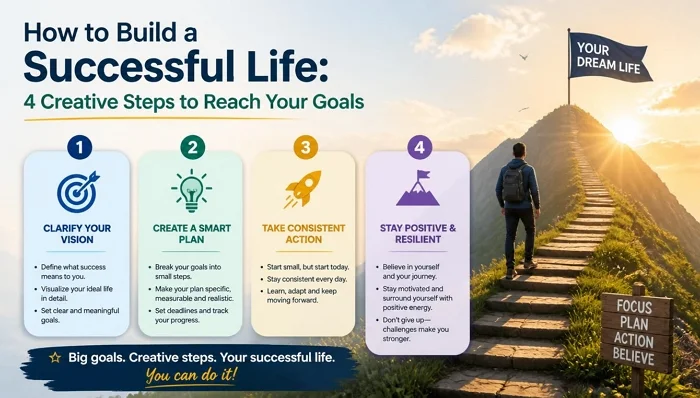
In this guide, we will explore four practical and creative steps to build a successful life and reach your goals. These steps are not a shortcut or a promise of instant transformation. They are a realistic framework for making better choices consistently.
1. Define What You Want From Your Life
It may sound obvious, but you cannot move toward a destination you have not chosen. Many people say they want a successful life, but they have never clearly described what that means to them.
A vague goal such as “I want to be happier” or “I want a better career” can be a useful starting point, but it is difficult to act on. Try turning it into something more specific:
- What kind of work would make you feel useful and engaged?
- What would a healthy relationship look like to you?
- How would you like to spend a normal weekday?
- What does financial security mean in your current situation?
- Which habits would support your physical and emotional well-being?
Specificity does not limit your possibilities. It gives your effort a direction.
Turn General Wishes Into Clear Goals
For example, saying “I want a good relationship” is not enough to guide your choices. What does a good relationship mean to you? It may involve mutual respect, honest communication, shared values, emotional support, or time spent together.
The same principle applies to every area of life. “I want to get healthier” becomes more actionable when you define whether your first step is walking three times a week, preparing more meals at home, improving your sleep routine, or speaking with a qualified professional about a health concern.
The goal is not to create a perfect plan. The goal is to understand what you are trying to build.
Focus on What You Want to Create
It is useful to recognize what you do not want. A difficult job may show you that you need a healthier work environment, and an unhealthy relationship may clarify the values you want in the future. However, if all of your attention stays focused on avoiding bad outcomes, you may never define a positive direction.
Try reframing your thoughts. Instead of saying, “I do not want to be exhausted all the time,” ask, “What would a more balanced week look like, and what is one change I can make?”
Your attention should lead to a practical decision. A clear vision becomes useful when it influences what you do next.
2. Take Consistent Steps in the Right Direction
Once you know what you want, your daily choices need to support it. A successful life is not created by intention alone. Your thoughts, words, and actions should gradually move in the same direction as your goals.
This does not mean that every action must be perfect. It means that your routine should contain more choices that support your priorities than choices that repeatedly undermine them.
If you want to improve your finances, learn about budgeting, track your spending, and make a realistic plan for saving or reducing debt. If you want to improve your career, develop a relevant skill, update your portfolio, or speak with people who work in the field. If you want stronger relationships, practice listening, communicate clearly, and make time for the people who matter to you.
Replace Excuses With the Next Small Action
Large goals can feel overwhelming because they require many steps. Instead of asking, “How will I change my entire life?” ask:
“What is the smallest useful action I can take today?”
That action might be sending one email, reading ten pages, taking a short walk, preparing a healthier meal, or spending 15 minutes learning a new skill. Small actions may seem unimpressive, but repeated actions create evidence that you are capable of progress.
The American Psychological Association has highlighted the value of identifying a goal, creating possible pathways toward it, and breaking large goals into smaller, manageable steps. This approach makes progress easier to see and gives you more than one way forward when an obstacle appears.
Align Your Habits With Your Priorities
Take a close look at your routine and ask whether it reflects the life you say you want. If health is important to you, does your schedule leave room for movement, sleep, and nourishing food? If peace is important, do your conversations and online habits constantly keep you stressed? If learning matters, do you protect some time for study?
You do not have to change everything at once. Choose one habit that will make the desired direction easier, then make it simple enough to repeat.
3. Be Patient and Flexible With Your Progress
Building a successful life takes time. It may take time to understand what you want, develop the skills you need, and see the results of consistent effort. Expecting immediate change can make you abandon a good plan before it has a chance to work.
Patience does not mean waiting passively. It means continuing to take useful action without demanding that every result appear on an artificial deadline.
Use Deadlines as Tools, Not Punishments
Deadlines can help you organize your effort, but they should not become a measure of your personal worth. A goal such as “I must have a new job by a specific date” may create unnecessary pressure when circumstances are outside your control.
A more flexible approach is to set a review date. For example, you might decide to apply for a certain number of suitable positions each week and review your strategy after one month. If the results are not improving, change the approach rather than attacking yourself.
This keeps you accountable while leaving room to learn.
Treat Setbacks as Information
A setback does not automatically mean that your goal is wrong or that you are incapable of success. It may show that your current strategy needs to change.
Perhaps you need more preparation, a different support system, a smaller first step, or a new route to the same outcome. Creative problem-solving often begins when you stop treating one failed approach as the only possible path.
Progress is rarely a straight line. The ability to adjust while keeping your values in view is one of the most useful skills you can develop.
4. Practice Gratitude and Appreciate Your Progress
Gratitude is not a reason to ignore serious problems or accept circumstances that need to change. It is a way to notice what is already working while you continue improving the parts of life that need attention.
You can be grateful for a supportive friend and still want healthier relationships. You can appreciate having a job while working toward a more fulfilling career. You can recognize progress with your health while continuing to build better habits.
This balanced view prevents your goals from turning into a constant feeling of not being enough.
Notice Small Wins
People often overlook small achievements because they are already focused on the next target. If you complete a difficult task, keep a promise to yourself, or take a step you had been avoiding, pause and acknowledge it.
The NHS recommends looking for positive moments and writing down three things that went well or that you appreciate at the end of the day. You can adapt this practice to your own life by recording one achievement, one source of gratitude, and one action you want to take tomorrow.
A simple daily note might look like this:
- Something I appreciated: A helpful conversation with a friend.
- Something I accomplished: I completed an important task before checking social media.
- My next step: I will spend 20 minutes improving a useful skill tomorrow.
This practice does not replace action. It helps you recognize that action is already producing progress.
Build a Life You Can Appreciate Now
It is easy to postpone happiness until you reach a certain income, relationship status, job title, or fitness goal. But if you never learn to appreciate the present, reaching the next goal may only create another reason to wait.
Enjoy the process where you can. Spend time with people you value, take care of your body, learn something interesting, and create moments that are meaningful today—not only in the future.
A successful life is not just a final result. It is also the quality of the days that lead you there.
How to Put These Four Steps Into Practice
Use the following exercise to turn the ideas in this article into a simple plan:
- Define one area to improve. Choose your health, career, finances, relationships, or personal growth.
- Describe the desired result. Write what success would look like in specific, realistic terms.
- Choose one action for this week. Make it small enough to complete even on a busy day.
- Set a review date. After seven days, ask what worked, what did not, and what you should change.
- Record your progress. Write down one action you completed and one thing you appreciate.
- Repeat and adjust. Keep moving forward, but change the method when the evidence shows that a different approach would work better.
Conclusion: Build Your Successful Life One Choice at a Time
Learning how to build a successful life is not about discovering one secret or following someone else’s definition of success. It is about becoming more intentional with the way you spend your time, make decisions, respond to setbacks, and care for the life you are creating.
Start by defining what you want. Then take consistent steps, give yourself time to grow, and appreciate the progress you make along the way. You do not need to rebuild your entire life in one day. You only need to choose the next useful step and repeat that process often enough for your direction to change.
Your life is shaped by many choices, including the small ones that seem insignificant at the time. Choose them with care, stay flexible, and keep moving toward a version of success that is genuinely meaningful to you.
2 Comments