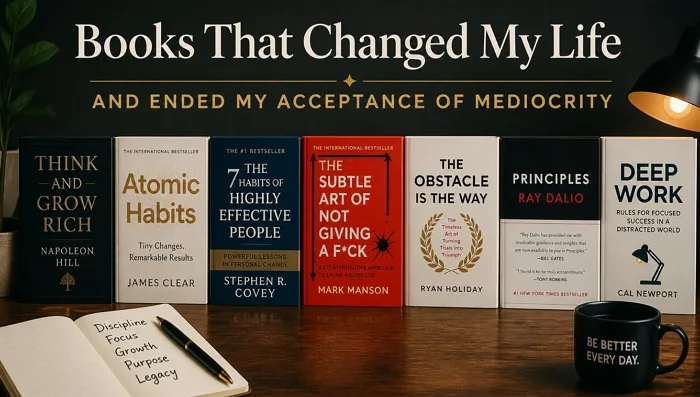
Someone once told me that where we find ourselves five years from now is closely connected to two things: the people we surround ourselves with and the books we read.
Looking back, I have come to appreciate just how powerful that idea can be. While I cannot personally introduce you to every wonderful person who has influenced my life, I can share something equally valuable: 15 books that challenged my thinking, reshaped my perspective, and changed the way I approach success, happiness, money, and personal growth.
These are not simply books to read and place on a shelf. They contain ideas worth reflecting on and principles that can make a real difference when you put them into practice.
Each one has influenced my life in a positive way, and I believe they can offer valuable lessons to anyone willing to learn, grow, and challenge their own limitations.
So, consider this your invitation to rethink what is possible. These 15 personal development books may change the way you approach your goals and help you stop settling for less than you are capable of achieving.
1. The Magic of Thinking Big by David J. Schwartz
Of all the books I have read, The Magic of Thinking Big is the one I have returned to most often. In fact, I have read it so many times that my personal copy has become worn, faded, and full of folded pages. That alone says something about the impact it has had on me.
David J. Schwartz challenges readers to raise their expectations, set ambitious goals, and stop allowing self-doubt to determine what they can accomplish.
One of the book’s most valuable lessons is that success does not necessarily depend on exceptional talent or extraordinary intelligence. Instead, the way we think, respond to challenges, and behave every day can play a major role in shaping our results.
The book explores practical ways to build confidence, overcome the fear of failure, think creatively, improve relationships, and develop leadership skills.
It also encourages readers to turn setbacks into opportunities and use meaningful goals as a guide for personal growth.
What makes this book especially valuable is its practical approach. Rather than simply encouraging readers to dream bigger, Schwartz explains how to develop the habits and attitudes that support those dreams.
I continue to return to this book because its message remains relevant: when you change the way you think about your potential, you can begin to change the way you live.
2. As a Man Thinketh by James Allen
As a Man Thinketh is a short but thought-provoking book about the relationship between our thoughts, character, and actions.
James Allen explores the idea that our inner world influences how we respond to the outer world. The thoughts we repeatedly entertain can shape our habits, affect our decisions, and influence the direction in which our lives move.
The book encourages readers to examine their thinking patterns instead of automatically blaming circumstances for every difficulty they experience.
For example, someone who constantly expects failure may hesitate to pursue opportunities, while someone who approaches challenges with patience and determination may be more willing to learn from mistakes and keep moving forward.
This does not mean that every life circumstance is under our personal control. External conditions matter, and not every setback can be overcome through attitude alone. However, the way we respond to those conditions can still make a meaningful difference.
Allen’s writing invites readers to become more conscious of their thoughts and take greater responsibility for their daily choices.
If you want a classic introduction to self-awareness, personal responsibility, and the power of mindset, this little book offers plenty to reflect on.
3. The Richest Man in Babylon by George S. Clason
Financial success is not simply about how much money you earn. It is also about how you manage what you have, how consistently you save, and how wisely you make financial decisions.
That is the central lesson behind The Richest Man in Babylon by George S. Clason.
Through stories inspired by ancient Babylon, Clason presents timeless financial principles in a simple and memorable way. Rather than overwhelming readers with complicated terminology, he uses relatable characters and situations to explain the foundations of personal money management.
The book emphasizes the importance of saving a portion of your income, controlling unnecessary spending, investing carefully, and learning how to protect the money you have accumulated.
It also encourages readers to seek knowledge before making financial commitments and to recognize the risks involved in opportunities that promise quick profits.
One of its strongest messages is that wealth is often built through consistent habits rather than dramatic overnight breakthroughs.
You do not need to become wealthy immediately to benefit from these principles. Even small improvements in budgeting, saving, and financial awareness can create a stronger foundation for the future.
For anyone interested in financial literacy, money management, and building long-term financial stability, this classic is an excellent place to begin.
Explore more personal development tips to improve yourself and build better habits.
4. Think and Grow Rich by Napoleon Hill
Few books have become as closely associated with success and ambition as Napoleon Hill’s Think and Grow Rich.
First published in 1937, the book explores the relationship between personal beliefs, clearly defined goals, persistence, and achievement. Hill argues that success begins with a definite purpose and a willingness to pursue it through sustained effort.
One of the concepts associated with the book is the Master Mind principle: bringing people together in a spirit of cooperation to work toward shared goals or support one another’s progress.
This idea remains relevant today. Whether you are building a business, advancing in your career, or pursuing a personal ambition, the people you learn from and collaborate with can influence your progress.
The book also emphasizes the importance of planning, self-discipline, decision-making, and maintaining a clear sense of direction.
Its message is not that positive thoughts automatically create wealth. Rather, it encourages readers to connect their ambitions with focused action, persistence, and a practical plan.
I consider this book particularly valuable for people who have goals but need a stronger framework for turning those goals into daily decisions.
If you want to develop a success-oriented mindset and become more intentional about your future, Think and Grow Rich is a classic worth exploring.
5. Acres of Diamonds by Russell H. Conwell
What if some of the opportunities you are searching for are closer than you think?
That question captures the central message of Acres of Diamonds by Russell H. Conwell, a speaker, educator, and founder of Temple University.
Based on Conwell’s famous lecture, the book encourages readers to recognize the possibilities available in their existing circumstances rather than assuming that success can only be found somewhere else.
It is easy to believe that a better job, a more successful business, or a more fulfilling life must begin with a dramatic change of location or a completely different set of circumstances.
Conwell challenges that assumption by encouraging people to look more carefully at their surroundings, skills, relationships, and resources.
Sometimes, an opportunity becomes visible only after we take the time to understand a problem, develop a useful skill, or recognize a need that others have overlooked.
The book also explores the relationship between material prosperity and deeper values, reminding readers that the pursuit of wealth should not become an excuse for selfishness or greed.
Its lesson is particularly relevant to entrepreneurs and people looking to improve their circumstances: before searching endlessly for something new, take a closer look at what you already have and what you could build from it.
Discover more inspiring books that can change your mindset and help you achieve success.
6. How to Win Friends and Influence People by Dale Carnegie
Success is rarely achieved in isolation. Our ability to communicate, build trust, resolve disagreements, and work with others can influence nearly every area of our lives.
Dale Carnegie’s How to Win Friends and Influence People remains one of the best-known books on interpersonal skills for precisely this reason.
First published in 1936, the book explains how to develop stronger relationships by showing genuine interest in other people, listening carefully, appreciating their contributions, and treating them with respect.
Carnegie also discusses the importance of avoiding unnecessary criticism, acknowledging our own mistakes, and trying to understand situations from another person’s point of view.
These principles can be useful in professional relationships, family life, friendships, and everyday conversations.
For example, a manager who listens before giving instructions may build greater trust with a team. Similarly, someone who approaches a disagreement with curiosity instead of hostility may find it easier to reach a constructive solution.
The book does not need to be interpreted as a guide to manipulating people. Its most enduring lessons are about empathy, communication, and creating relationships in which people feel heard and valued.
If you want to improve your social confidence, leadership abilities, and communication skills, this is one personal development classic worth keeping close.
7. The Power of Positive Thinking by Norman Vincent Peale
Our attitudes influence how we interpret challenges, respond to disappointment, and approach new opportunities.
In The Power of Positive Thinking, Norman Vincent Peale explores how faith, optimism, and confidence can help people face difficulties with a more constructive outlook.
The book encourages readers to challenge defeatist thinking, develop greater self-belief, and focus on the actions they can take instead of becoming consumed by fear or discouragement.
Peale’s approach combines motivational guidance with spiritual principles. For readers who appreciate that perspective, the book can offer encouragement during periods of uncertainty or personal struggle.
One useful takeaway is the importance of recognizing the difference between a temporary setback and a permanent judgment about your abilities.
Making a mistake does not mean that you are incapable. Facing rejection does not mean that every future opportunity will end the same way.
Positive thinking, however, should not be confused with ignoring real problems. A constructive attitude works best when it is combined with honest self-assessment, realistic planning, and practical action.
Read with that balance in mind, The Power of Positive Thinking can serve as a reminder to approach life with greater hope, confidence, and resilience.
Learn how to set meaningful goals and turn your ambitions into achievable results.
8. Rich Dad Poor Dad by Robert T. Kiyosaki
Many people spend years learning how to earn money without ever learning how to manage it effectively.
In Rich Dad Poor Dad, Robert T. Kiyosaki explores this gap through stories about two contrasting approaches to work, money, education, and financial independence.
The book encourages readers to question common assumptions about wealth and examine how their financial decisions influence their long-term options.
Kiyosaki discusses financial education, cash flow, assets, liabilities, entrepreneurship, and the importance of understanding how money moves.
One of the book’s most important contributions is its encouragement to become more financially aware rather than relying entirely on a paycheck or assuming that earning more automatically leads to financial security.
Readers are encouraged to learn about budgeting, investing, business ownership, and the risks associated with different financial choices.
It is worth remembering that the book presents a particular perspective on personal finance, and not every recommendation will suit every person’s circumstances. Its concepts should be evaluated carefully rather than treated as guaranteed formulas for becoming wealthy.
Nevertheless, Rich Dad Poor Dad can be a useful starting point for people who want to question their financial habits and develop a more informed relationship with money.
9. Success Through a Positive Mental Attitude by Napoleon Hill and W. Clement Stone
How much difference can your attitude make when life does not go according to plan?
In Success Through a Positive Mental Attitude, Napoleon Hill and W. Clement Stone explore the role that attitudes, beliefs, and personal choices can play in the pursuit of success.
The book contrasts a positive mental attitude, commonly abbreviated as PMA, with a negative mental attitude, or NMA.
Its central argument is that the way we interpret circumstances can influence how we respond to them. A constructive outlook may encourage us to search for solutions, learn from mistakes, and continue working toward meaningful goals.
A consistently negative outlook, by contrast, can make it harder to recognize opportunities or take useful action.
The authors also emphasize the importance of persistence, personal initiative, and developing habits that support long-term progress.
Imagine two people facing the same professional setback. One assumes that the setback proves they cannot succeed, while the other examines what went wrong and identifies ways to improve. Their circumstances may initially be similar, but their responses can lead them in different directions.
Of course, attitude alone cannot eliminate every obstacle. Circumstances, resources, and access to opportunities also matter.
The value of this book lies in its reminder that, even when we cannot control everything around us, we can often improve the way we respond.
Read more about positive thinking and how to develop a stronger success mindset.
10. Seeds of Greatness by Denis Waitley
A meaningful life is rarely built through one dramatic decision. More often, it develops through small habits, repeated choices, and the values we practice over time.
In Seeds of Greatness, Denis Waitley explores the qualities and principles that can help people develop their potential and live more purposeful lives.
Waitley, known for his work in human performance and motivation, focuses on the relationship between personal values, self-image, discipline, and achievement.
The book encourages readers to think beyond short-term rewards and consider the kind of person they want to become.
That might involve developing stronger habits, improving relationships, becoming more responsible, or learning to approach challenges with greater confidence.
Its central metaphor is simple: the seeds we plant through our everyday decisions can influence the results we experience in the future.
For example, consistently investing time in learning can gradually strengthen your skills. Practicing honesty can build trust in relationships. Setting aside time for reflection can help you recognize patterns that need to change.
These improvements may not produce immediate results, but their cumulative effect can be meaningful.
If you are looking for a personal growth book that encourages you to examine your values and develop a more purposeful approach to life, Seeds of Greatness is worth considering.
11. The Success System That Never Fails by W. Clement Stone
Why do some people continue making progress toward their goals while others repeatedly lose direction?
In The Success System That Never Fails, W. Clement Stone explores the principles, habits, and organized approaches that can support personal and professional achievement.
The book encourages readers to look for practical systems instead of depending entirely on inspiration or waiting for the perfect opportunity.
Success often becomes easier to pursue when a large ambition is broken into manageable steps. A clear plan can help you decide what to do, measure your progress, and recognize where changes are needed.
Stone’s approach emphasizes learning, experience, persistence, and the value of applying principles consistently.
This message is useful because motivation naturally rises and falls. A person who relies only on enthusiasm may struggle to maintain progress when work becomes difficult or results take longer than expected.
A practical system provides a structure to return to, even on days when motivation is limited.
For example, someone hoping to grow a business might establish weekly sales goals, review customer feedback, track expenses, and regularly improve their marketing strategy.
The broader lesson is that success is not just about knowing what you want. It is also about developing a repeatable process that helps you move toward it.
Explore practical strategies for self-improvement, motivation, and personal growth.
12. The Greatest Salesman in the World by Og Mandino
Despite its title, The Greatest Salesman in the World is about much more than selling products or persuading customers.
Written by Og Mandino, this inspirational book uses a story-based approach to explore the habits and personal qualities that can support a more disciplined and purposeful life.
Its lessons revolve around persistence, patience, positive habits, self-control, and the importance of continuing to improve through everyday actions.
Rather than presenting success as the result of one brilliant idea, Mandino emphasizes the power of consistent behavior.
That principle applies to many areas beyond sales. A student can improve through regular study. An entrepreneur can build trust through dependable service. A professional can develop expertise by practicing and learning from experience.
The book’s storytelling format makes its lessons accessible to readers who prefer inspiration through narrative rather than a traditional instructional guide.
One of its most useful messages is that lasting change often begins with the habits we repeat when nobody is watching.
If you are looking for an encouraging book about discipline, perseverance, and personal responsibility, this classic offers a memorable approach to those themes.
13. The Message by Eugene H. Peterson
Not every book that changes the way we think needs to focus on business, productivity, or financial achievement.
For many readers, spiritual reflection provides an equally important foundation for personal growth. The Message, created by Eugene H. Peterson, is a contemporary-language rendering of the Bible designed to make its meaning more accessible to modern readers.
Its conversational style offers a different reading experience from more traditional Bible translations, using everyday language to communicate biblical narratives, teachings, poetry, and spiritual themes.
For readers who find traditional wording difficult to follow, this version may make it easier to engage with familiar passages and reflect on their relevance to daily life.
Its value depends partly on the reader’s interests and beliefs. Those who approach it as a spiritual text may appreciate its emphasis on faith, relationships, compassion, humility, and purpose.
The book also serves as a reminder that a fulfilling life cannot always be measured through professional achievements or financial results alone.
Taking time to reflect on values, responsibilities, and relationships can help people consider what success means to them beyond external recognition.
For readers interested in accessible biblical reading and spiritual reflection, The Message offers a distinctive approach.
Discover effective ways to improve your productivity, strengthen your discipline, and stay focused on your goals.
14. Crush It!: Why NOW Is the Time to Cash In on Your Passion by Gary Vaynerchuk
What if you could turn something you genuinely enjoy into a business or a professional opportunity?
In Crush It!, entrepreneur Gary Vaynerchuk explores how people can use digital platforms, content creation, and personal branding to build opportunities around their interests.
Drawing on his experience growing a business and developing an online presence through wine-related content, Vaynerchuk explains how the internet can help people connect with audiences beyond their immediate communities.
The book encourages readers to identify their strengths, share useful or entertaining content, build relationships with an audience, and approach their work with consistency.
Its ideas are especially relevant to aspiring creators, freelancers, entrepreneurs, and professionals who want to establish a recognizable presence online.
For example, someone who enjoys cooking could publish recipes and practical tutorials. A designer could share project breakdowns and creative advice. A fitness enthusiast could produce educational content based on appropriate training and nutrition principles.
Over time, valuable content and genuine audience engagement may create opportunities for services, partnerships, or products.
However, turning a passion into a sustainable income takes more than enthusiasm. It requires research, patience, business planning, and an understanding of what an audience actually needs.
Crush It! remains an encouraging read for anyone interested in personal branding, digital entrepreneurship, and building a career around a genuine interest.
15. The Essential Writings of Ralph Waldo Emerson
Sometimes, the most valuable books are those that challenge us to think more deeply rather than simply tell us what to do.
The Essential Writings of Ralph Waldo Emerson brings together important works by one of the influential voices associated with American transcendentalism.
Emerson’s essays and other writings explore individuality, independent thought, self-reliance, nature, and the relationship between personal experience and broader truths.
His work encourages readers to question inherited assumptions, think for themselves, and develop a clearer understanding of their own values.
These ideas remain relevant in a world where people are constantly exposed to other people’s opinions, expectations, and definitions of success.
It is easy to measure our progress against someone else’s career, income, lifestyle, or public image. Emerson’s emphasis on independent thought invites a different question: are we building a life that reflects our own considered values, or simply following expectations we have never examined?
His writing can also encourage a more thoughtful appreciation of nature, creativity, and the intellectual life.
This is not necessarily a quick or easy read for everyone. Emerson’s essays reward patience and reflection more than hurried reading.
But for those willing to spend time with his ideas, The Essential Writings of Ralph Waldo Emerson can offer a deeper perspective on individuality, personal responsibility, and what it means to live deliberately.
Learn more about financial literacy and the habits that support long-term financial success.
How to Get the Most Out of These Personal Development Books
Reading inspiring books can introduce you to new ideas, but the real value often comes from applying what you learn.
You do not need to read all 15 books at once or attempt to change every part of your life overnight. A more sustainable approach is to choose one book that addresses a challenge you are currently facing and work through it thoughtfully.
Here are a few ways to turn reading into meaningful progress.
1. Choose a Book That Matches Your Current Goals
Start by identifying the area of your life you want to improve.
If you want to develop a stronger mindset, consider The Magic of Thinking Big. If you want to improve your financial habits, begin with The Richest Man in Babylon. If relationships and communication are your priorities, How to Win Friends and Influence People may be a useful choice.
A clear purpose can make your reading more focused and relevant.
2. Take Notes on the Ideas That Matter Most
When you encounter an idea that challenges your assumptions or offers a practical solution, write it down.
You do not need to summarize every chapter. Instead, focus on lessons you can realistically apply to your work, relationships, finances, or personal routines.
Reviewing these notes later can help you remember what you learned and recognize which ideas deserve further attention.
3. Turn One Lesson Into a Daily Habit
Rather than attempting to apply everything at once, choose one specific action.
You might set aside time each day to work toward an important goal, review your spending every week, or practice listening more carefully during conversations.
Small, consistent actions are often easier to maintain than dramatic changes that depend on temporary enthusiasm.
4. Evaluate the Advice Critically
Not every recommendation in a personal development book will suit every person or situation.
Consider the author’s perspective, examine the evidence behind important claims, and adapt useful ideas to your circumstances. In particular, treat financial advice as a starting point for further learning rather than a guarantee of wealth.
The goal is not to accept every sentence as unquestionable truth. It is to develop your judgment and identify principles that genuinely help you make better decisions.
5. Revisit the Books That Continue to Help You
Some books become more meaningful as your circumstances change.
A lesson that seems abstract when you first encounter it may become much clearer after a career change, a financial challenge, or an important personal decision.
Returning to a useful book can help you notice new insights and reconsider how its ideas apply to your current stage of life.
Find more helpful insights on building confidence, improving your mindset, and creating a more fulfilling life.
Final Thoughts: Stop Settling and Start Growing
The 15 books in this list cover a wide range of subjects, from positive thinking and financial literacy to communication, entrepreneurship, spirituality, and independent thought.
What connects them is their invitation to examine the way we live and consider what we could do differently.
You may not agree with every idea in every book, and you do not need to. The purpose of reading is not simply to collect motivational quotes or fill your shelves with popular titles. It is to discover ideas that help you think more clearly, make wiser choices, and take meaningful action.
You do not need to transform your entire life in a single week. You can begin with one book, one useful lesson, and one small change.
Over time, those changes may influence your habits, relationships, confidence, and approach to your goals.
So choose the book that speaks to your current needs, give it your attention, and put its most valuable lessons into practice.
Because personal growth is not about becoming perfect or comparing yourself endlessly with others. It is about continuing to learn, making deliberate choices, and building a life that better reflects your values and potential.
References
- Penguin Random House – The Magic of Thinking Big by David J. Schwartz (Official publisher information about the book’s principles of confidence, goal setting, leadership, and personal success.)
- Simon & Schuster – As a Man Thinketh by James Allen (Book details and background on the relationship between thought, character, and personal development.)
- Penguin Random House – The Richest Man in Babylon by George S. Clason (Publisher’s overview of this classic’s lessons on saving, financial planning, and building wealth.)
- Simon & Schuster – Think and Grow Rich by Napoleon Hill (Book information covering goal setting, persistence, motivation, and the author’s philosophy of achievement.)
- Dale Carnegie – How to Win Friends and Influence People (Official book page explaining communication, interpersonal relationships, and effective leadership.)
- Temple University – Temple University Official Website (Institutional background relevant to Russell H. Conwell, the founder of Temple University and author of Acres of Diamonds.)
3 Comments